


The global real estate market is a behemoth, valued at an estimated $280.6 trillion at the end of 2017, making up more than 77 percent of the world’s wealth. Within this vast market, retail properties such as shopping centers, strip malls, and standalone stores play a significant role. The success of these investments heavily depends on factors like location and foot traffic.
At Clients1st Property Group, based in Charlotte, North Carolina, we understand the complexities of analyzing retail property investments. Our expertise can guide investors through the essential steps and considerations, providing a structured approach to making informed decisions in today’s evolving market landscape.
Key Takeaways
- Understand the four-factor diamond framework for successful retail real estate investments.
- Learn how to evaluate location factors and tenant profiles.
- Discover the importance of financial metrics and physical property conditions.
- Identify potential risks and opportunities in retail properties.
- Build a profitable portfolio despite the challenges posed by e-commerce.
Understanding the Retail Real Estate Landscape
Understanding the retail real estate market requires insight into its diverse property types and current trends. The retail industry’s evolution is driven by economic conditions, consumer preferences, and technological advancements.
Types of Retail Properties
Retail properties encompass a range of formats, including shopping malls, strip centers, and standalone stores. Mixed-use developments are becoming increasingly popular, combining retail with residential, office, or hospitality components to create vibrant, dynamic environments.
| Type of Retail Property | Description |
|---|---|
| Shopping Malls | Large, enclosed buildings housing multiple retailers |
| Strip Centers | Outdoor shopping centers with a linear configuration |
| Standalone Stores | Single retail buildings not part of a larger complex |
Current Market Trends in Retail Real Estate
The retail real estate market is experiencing significant transformation due to e-commerce growth. Successful properties are adapting by incorporating experiential elements that cannot be replicated online.
- Retailers are adopting omnichannel strategies, using physical stores as showrooms and brand experience centers.
- Health and wellness tenants, service-based businesses, and food and beverage operators are taking larger shares of retail space.
Understanding these evolving trends is crucial for investors to identify properties with sustainable demand and potential for long-term appreciation.
How to Analyze Retail Property Investment: A Step-by-Step Approach

Investors seeking to maximize returns must thoroughly analyze retail properties using a structured methodology. At Clients1st Property Group, located in Charlotte, North Carolina, we guide investors through this process with expertise and precision.
Initial Assessment Criteria
When evaluating retail property investments, initial assessment criteria play a crucial role. Investors should first examine the property’s location, considering demographics, accessibility, and visibility. A thorough analysis of the local market dynamics, including consumer spending patterns and competitive landscape, is also essential.
| Criteria | Description | Importance |
|---|---|---|
| Location | Demographic analysis, accessibility, and visibility | High |
| Market Dynamics | Consumer spending patterns and competitive landscape | High |
| Financial Performance | Historical and projected income, expenses, and cash flow | High |
The Four-Factor Diamond Framework
The Four-Factor Diamond Framework provides a comprehensive approach to analyzing retail property investments by examining four interconnected elements: the physical property, market dynamics, financial performance, and tenant profile. This framework, utilized by experts at Clients1st Property Group, ensures that investors consider all critical factors influencing property value and income.
- Physical property analysis evaluates the building’s condition and potential for value-add improvements.
- Market dynamics assessment examines local retail trends and economic indicators.
- Financial performance analysis involves evaluating historical and projected income and expenses.
- Tenant profile examination assesses the quality and stability of existing tenants.
For more information on analyzing retail property investments, you can contact Clients1st Property Group at (704) 622-4865.
Evaluating Location: The Foundation of Retail Success
Understanding the importance of location is crucial for investors seeking to make informed decisions in the retail real estate market. The location of a retail property is a fundamental factor that influences its potential for success.
Demographics and Consumer Behavior Analysis
Analyzing demographics and consumer behavior is vital to understanding the demand for retail in a given area. Investors should research the local population’s age, income levels, and spending habits to determine if there’s a strong demand for the type of retail property they’re considering.
Accessibility and Visibility Factors
A retail property’s accessibility and visibility are critical to its success. Investors should assess the property’s proximity to major roads, public transportation, and other amenities that could impact foot traffic. High visibility and easy access can significantly enhance a property’s attractiveness to potential tenants.
Competitive Landscape Assessment
Assessing the competitive landscape is essential to understanding the market dynamics. This involves analyzing competing retail properties within the trade area, including their tenant mix, rental rates, and occupancy levels.
- Mapping competing retail properties helps investors understand the market saturation and potential for new entrants.
- Evaluating the age, condition, and amenities of competing properties reveals opportunities for differentiation.
| Competitive Factor | Description | Impact on Retail Property |
|---|---|---|
| Tenant Mix | Variety and quality of tenants | A diverse tenant mix can enhance the property’s appeal. |
| Rental Rates | Comparison of rental rates among competing properties | Higher rental rates may indicate a strong demand, while lower rates could signal oversupply. |
| Occupancy Levels | Percentage of occupied space in competing properties | High occupancy rates typically indicate a healthy market. |
Tenant Profile Analysis: Ensuring Stable Income

Investors must conduct a detailed tenant profile analysis to secure stable income from their retail property investments. A thorough examination of the tenant mix and lease structures is crucial for understanding the potential risks and rewards associated with a property.
Assessing Tenant Mix and Quality
The quality and diversity of tenants directly impact the stability of a retail property’s income. A well-balanced tenant mix reduces dependence on a single tenant, thereby mitigating the risk of significant income loss if one tenant defaults or vacates. “A diverse tenant base is key to maintaining consistent cash flow,” as it spreads out the risk across various businesses and industries.
Evaluating the creditworthiness of tenants is also essential. Investors should analyze the financial health and business performance of major tenants to assess the likelihood of timely rent payments.
Lease Structure Evaluation
Analyzing the lease structure is vital for understanding the income stability of a retail property. Lease terms, including duration, renewal options, and escalation clauses, play a significant role in determining the property’s cash flow. Longer-term leases with structured rent increases can provide a steady income stream, enhancing the property’s value.
- Examining lease expiration schedules to avoid clustering expirations that could lead to significant income risk.
- Understanding rent escalation provisions, such as fixed percentage increases or CPI adjustments, to ensure they keep pace with inflation.
- Reviewing additional rent components like percentage rent, CAM recoveries, and tax/insurance pass-throughs that impact net operating income.
Financial Due Diligence for Retail Properties
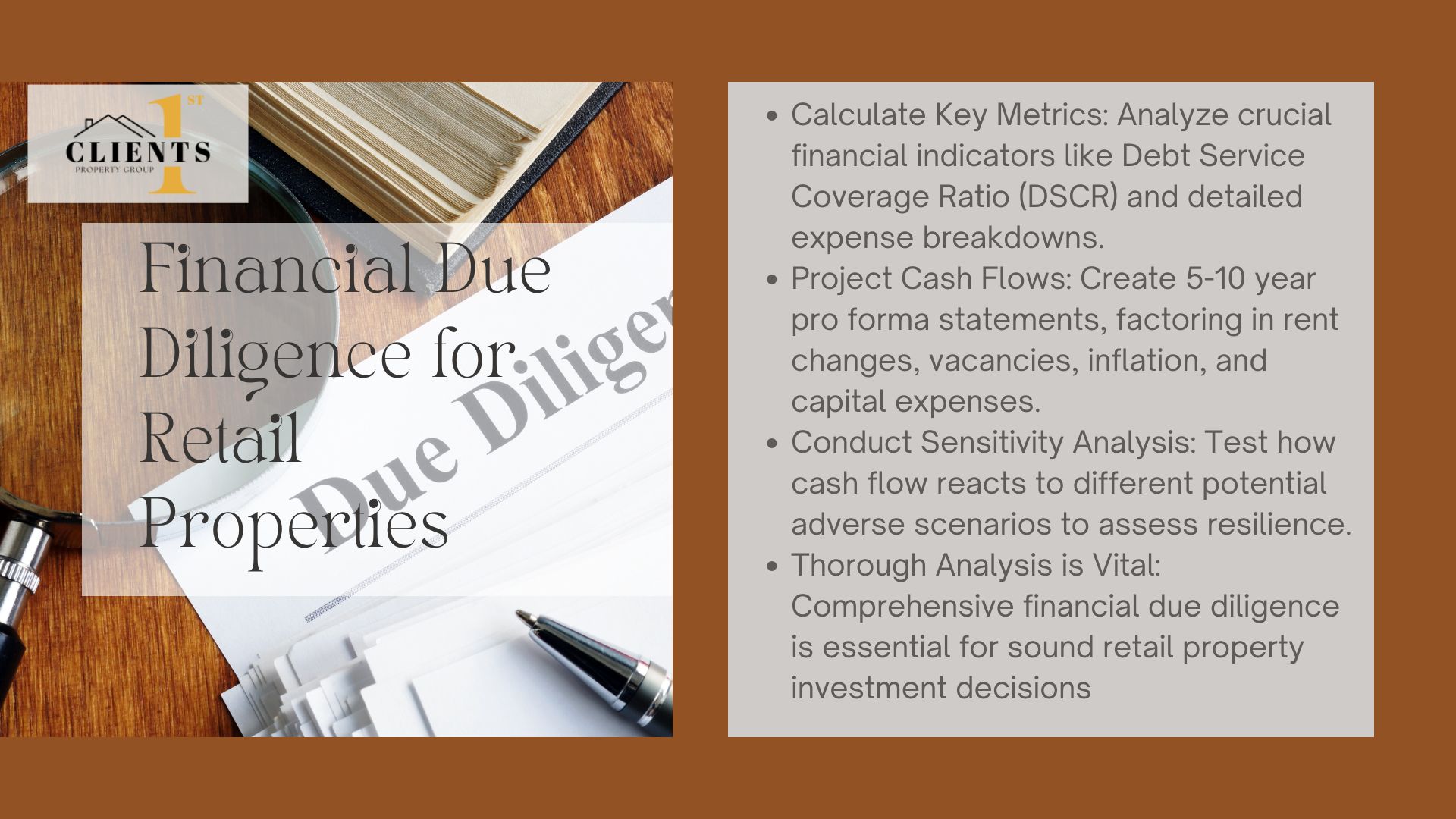
To ensure a sound investment, retail property investors must perform comprehensive financial due diligence. This process involves analyzing various financial metrics and projections to gauge the property’s potential for generating stable income and returns on investment.
Key Financial Metrics to Calculate
When evaluating a retail property, investors should focus on key financial metrics that provide insights into its financial health. One crucial metric is the Debt Service Coverage Ratio (DSCR), which should ideally be above 1.25 to be considered healthy. Investors should also analyze the breakdown of expenses, including maintenance, taxes, insurance, and management fees, to understand the property’s cash flow dynamics.
Cash Flow Analysis and Projections
Cash flow analysis begins with creating a detailed pro forma that projects income and expenses over a 5-10 year holding period. This involves accounting for rent increases, vacancy allowances, and operating expense inflation. Key considerations include:
- Realistic vacancy and credit loss projections based on historical property performance and market conditions.
- Incorporating capital expenditure planning for major maintenance items like roof replacements and HVAC systems.
- Sensitivity analysis to test how cash flow responds to various adverse scenarios.
- Debt service analysis to examine the impact of financing terms on cash flow.
By carefully analyzing these factors, investors can better understand the property’s resilience and potential for long-term financial stability.
“A comprehensive cash flow analysis is critical for investors to assess the viability of their investment and make strategic decisions.”
Therefore, thorough financial due diligence is not just a precaution but a necessity for successful retail property investment.
Physical Property Assessment and Risk Management
Conducting a thorough physical property assessment is crucial for understanding the true value and potential risks associated with a retail property investment. This process involves evaluating the property’s condition, identifying potential risks, and implementing strategies to mitigate these risks.
Building Condition and Maintenance Requirements
A comprehensive assessment of the building’s condition is essential to identify any necessary repairs or maintenance. This includes evaluating the structural integrity, condition of major systems (such as HVAC and electrical), and identifying any signs of deferred maintenance. For example, a property with an outdated HVAC system may require significant investment to upgrade, impacting the overall return on investment.
Identifying and Mitigating Investment Risks
Retail property investments carry various risks, including environmental hazards, market fluctuations, and regulatory changes. To mitigate these risks, investors should conduct thorough due diligence, including environmental risk assessments and market analysis. Key considerations include:
- Environmental risk assessment to identify potential contamination issues.
- Market-specific risks such as overbuilding or shifting retail corridors.
- Tenant concentration risk evaluation to assess dependence on a single tenant.
- Insurance coverage analysis to ensure adequate protection.
- Regulatory risk assessment to examine potential zoning changes or new ordinances.
By understanding and addressing these risks, investors can make more informed decisions and protect their investment. Effective risk management is critical to the long-term success of retail property investments.
| Risk Category | Description | Mitigation Strategy |
|---|---|---|
| Environmental Risk | Potential contamination from current or previous property uses. | Phase I environmental site assessments. |
| Market Risk | Overbuilding, shifting retail corridors, or changing consumer preferences. | Market analysis and flexible exit strategies. |
| Tenant Concentration Risk | Dependence on a single tenant or retail category. | Diversification of tenant mix. |
Market and External Environment Considerations
The viability of retail property investments is closely tied to broader market and economic conditions. Investors must consider various external factors to make informed decisions.
Economic Indicators and Their Impact
Economic indicators such as GDP growth, unemployment rates, and consumer spending patterns significantly influence the retail property market. For instance, a growing economy with low unemployment typically boosts consumer confidence and spending, positively impacting retail sales and, consequently, retail property values.
Investors should monitor these indicators to anticipate market trends and adjust their strategies accordingly. A robust economy can lead to increased demand for retail space, while economic downturns may result in higher vacancy rates.
| Economic Indicator | Impact on Retail Property |
|---|---|
| GDP Growth | Increased consumer spending, higher demand for retail space |
| Unemployment Rate | Low unemployment boosts consumer confidence and retail sales |
| Consumer Spending | Directly affects retail sales and property values |
E-commerce Influence on Brick-and-Mortar Retail
The rise of e-commerce has significantly impacted brick-and-mortar retail, with many retailers adopting omnichannel strategies to remain competitive. Investors should consider properties that can accommodate last-mile delivery or incorporate hybrid shopping models.
- E-commerce penetration analysis helps identify retail categories vulnerable to online competition.
- Omnichannel retail strategies are crucial, with physical locations serving as showrooms and fulfillment centers.
- Experiential retail concepts offering services and entertainment are proving resilient to e-commerce competition.
Conclusion: Making Informed Retail Property Investment Decisions with Clients 1st Property Group
Making informed retail property investment decisions demands a deep dive into location, tenant profile, financials, and market trends. Successful retail property investment requires a methodical, comprehensive approach that considers location quality, tenant strength, financial performance, and physical condition within the context of evolving market trends. Clients1st Property Group in Charlotte, North Carolina, offers expert guidance through the complex process of retail property analysis, helping investors identify opportunities that align with their financial goals and risk tolerance.
By applying the analytical framework outlined in this guide, investors can make confident decisions backed by thorough due diligence and market knowledge. For personalized assistance with retail property investment analysis in the Charlotte area, contact Clients1st Property Group at (704)622-4865 to leverage their local expertise and industry knowledge in the real estate estate sector.