


Building long-term wealth often starts with smart investments. For many, rental properties and other real estate investment strategies offer a path to steady cash flow with minimal daily effort. Whether you’re exploring REITs or physical properties, understanding the balance between active management and hands-off approaches is key.
Active involvement might include tasks like tenant coordination or repairs. In contrast, passive real estate models prioritize systems that generate returns without constant oversight. This distinction helps investors align their goals with strategies that fit their lifestyle.
Clients 1st Property Group, based in Charlotte, NC, specializes in guiding newcomers and seasoned investors through these decisions. Their team simplifies complex topics—from property selection to ROI analysis—so clients can make informed choices. Reach them at (704) 622-4865 for personalized advice.
This guide explores actionable steps to diversify income streams through property ownership. You’ll learn about risk management, market trends, and success stories that highlight achievable outcomes. Let’s begin your journey toward financial flexibility.
Key Takeaways
- Passive strategies prioritize minimal daily effort while generating consistent returns.
- Understanding active vs. passive management shapes investment success.
- Local expertise, like Clients 1st Property Group, enhances decision-making.
- Multiple options exist, including rentals, REITs, and syndications.
- Long-term growth requires balancing risk and market knowledge.
Understanding Passive Income in Real Estate
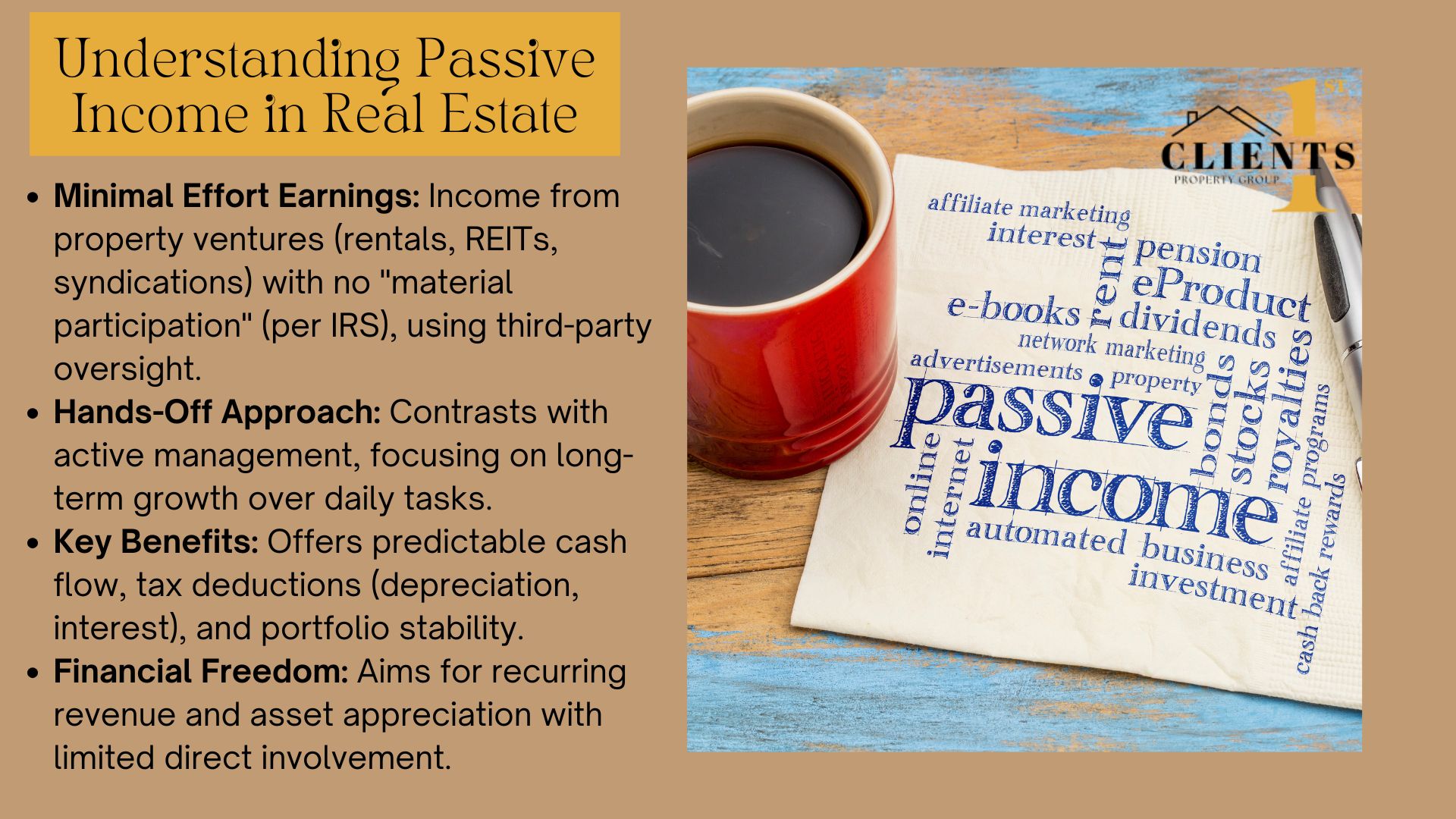
Achieving financial independence often hinges on strategic asset allocation. For those exploring real estate investments, passive models allow earnings to accumulate with limited hands-on work. The IRS defines this income type as revenue from ventures requiring no “material participation”—ideal for investors prioritizing flexibility.
Defining Passive Income
Passive earnings in property typically come from rentals, estate investment trusts (REITs), or syndications. Unlike active management—which involves tenant interactions or repairs—these methods rely on third-party oversight. This structure lets investors focus on long-term growth rather than daily tasks.
Benefits of Real Estate as an Income Stream
Property ownership offers predictable cash flow through lease agreements or dividend-paying REITs. Tax deductions for depreciation and mortgage interest further enhance returns. Diversifying with real estate income also stabilizes portfolios against market volatility.
Charlotte’s Clients 1st Property Group simplifies entry for newcomers. Their team analyzes local trends to match clients with low-maintenance opportunities, from syndicated deals to REITs. This guidance helps investors balance risk while building equity over time.
Whether through rental properties or pooled funds, real estate investments provide multiple paths to wealth. By minimizing direct involvement, you gain freedom to explore other ventures while assets appreciate steadily.
The Basics of Real Estate Investing for Passive Income
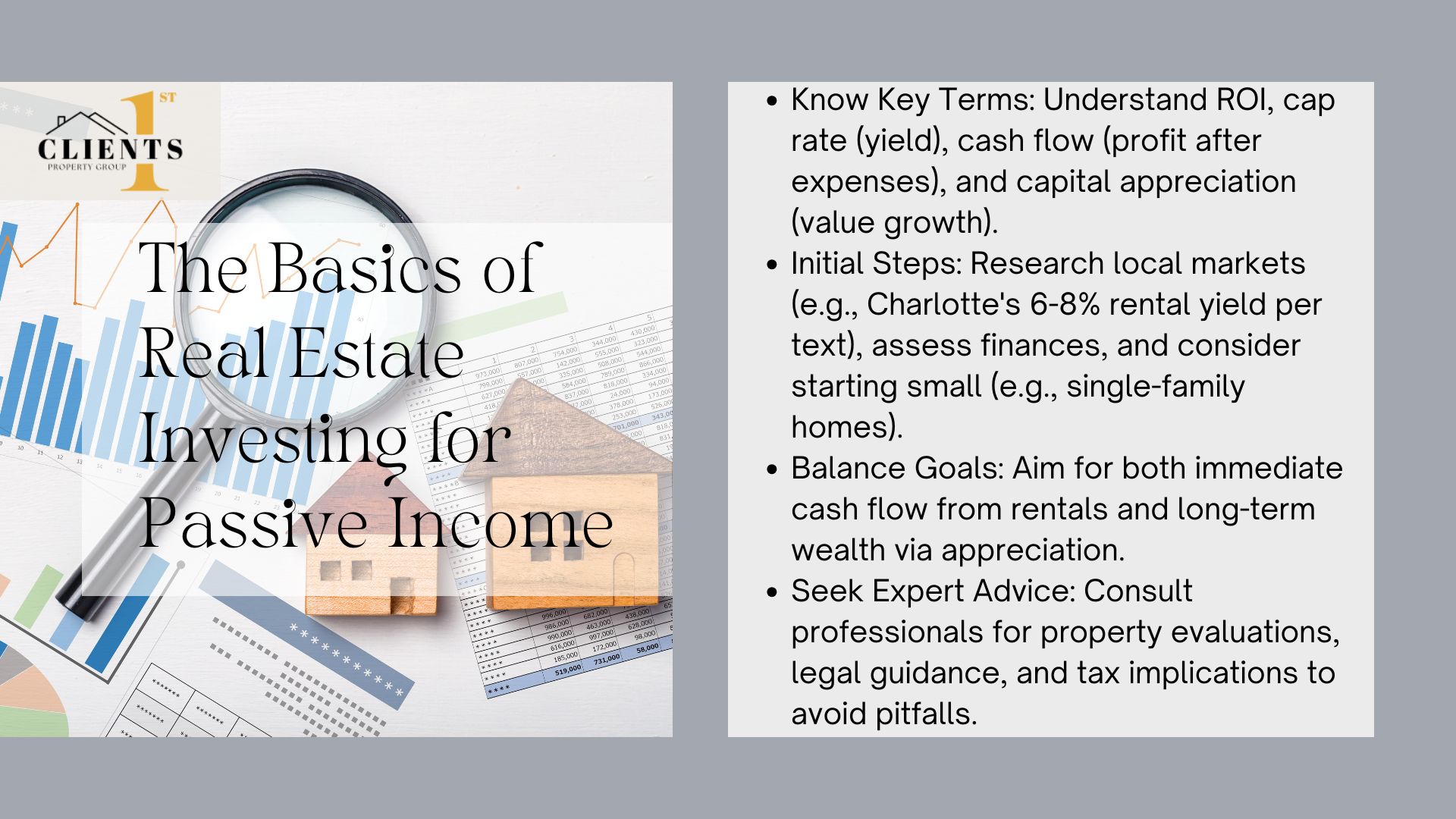
Navigating property markets requires foundational knowledge of core concepts. Understanding terms like ROI and cash flow helps investors evaluate opportunities confidently. Let’s break down essential elements for building sustainable estate investment strategies.
Key Investment Terms
ROI (Return on Investment) measures profitability relative to costs. For example, a $10,000 annual return on a $200,000 property equals a 5% ROI. Cap rate calculates a property’s potential yield by dividing net income by its market value.
| Term | Purpose | Example |
|---|---|---|
| Cash Flow | Monthly profit after expenses | $1,500 rent – $1,200 costs = $300 |
| Capital Appreciation | Value growth over time | Property bought for $300k, now worth $350k |
| REITs | Pooled fund investments | Earn dividends from commercial properties |
Rental income provides immediate cash flow, while appreciation builds long-term wealth. Clients 1st Property Group often advises clients to balance both for diversified earnings.
Initial Steps to Invest
Begin by researching local markets. Charlotte’s average rental yield, for instance, sits at 6-8%, making it ideal for starters. Next, assess your budget and financing options—many investors use conventional loans or partnerships.
Consider starting with single-family homes. They require less upfront capital than multi-unit buildings. Partnering with firms like Clients 1st simplifies property evaluations, ensuring you avoid overpriced listings or hidden repair costs.
Finally, consult experts to navigate legal requirements and tax implications. Knowledge gaps can turn promising deals into financial pitfalls. Structured guidance transforms complex processes into manageable steps.
Active vs. Passive Real Estate Investing
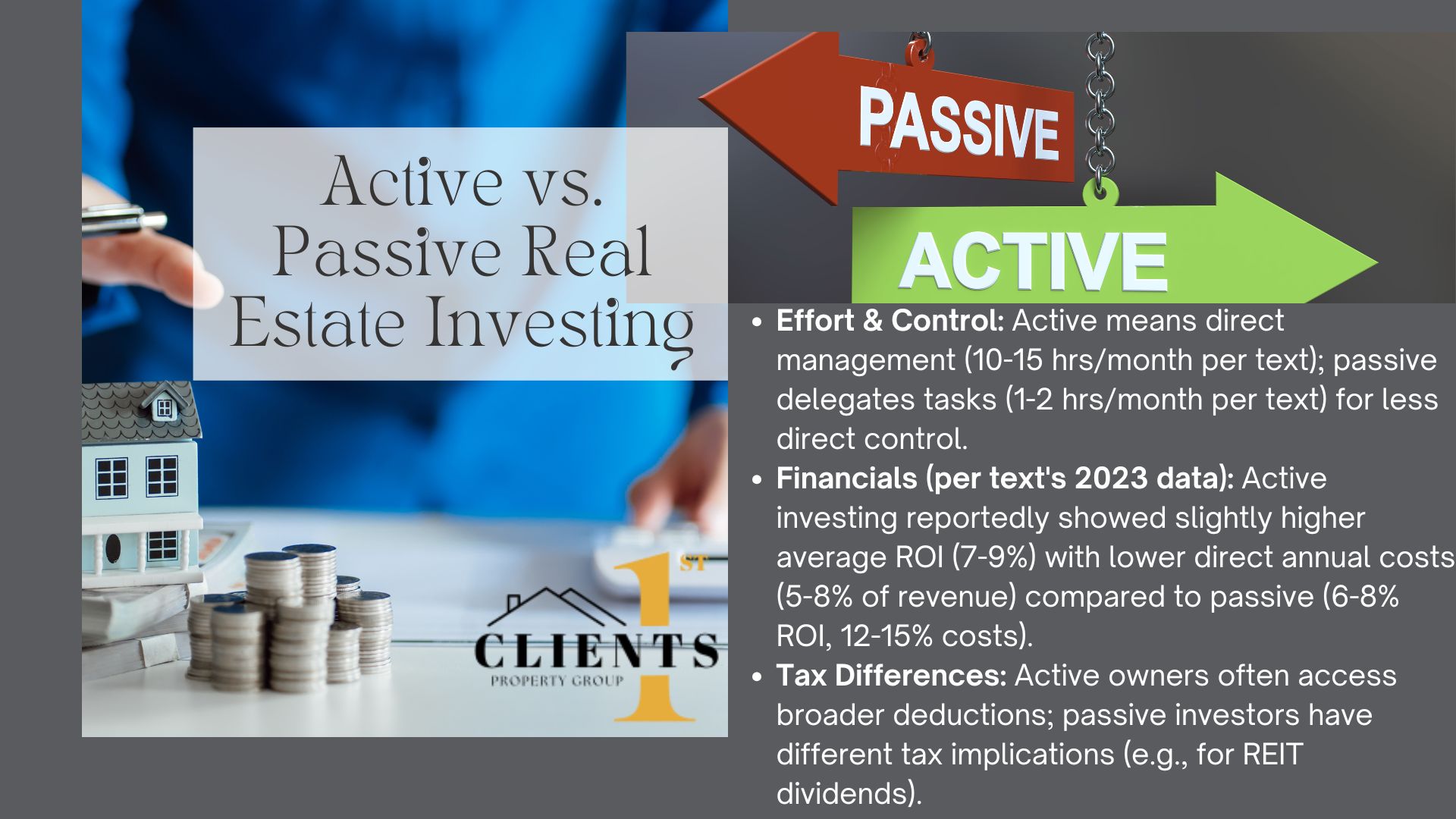
Balancing time commitments and financial returns shapes every investor’s strategy. While some prefer direct control, others prioritize systems that work autonomously. Understanding these approaches ensures alignment with personal goals and lifestyle needs.
Management Effort: Hands-On vs. Hands-Off
Active estate investing often involves managing rental properties directly. Landlords handle tenant screening, maintenance requests, and lease agreements—tasks consuming 10-15 hours monthly. Missed repairs or vacancies can quickly turn profits into losses.
Passive models delegate these responsibilities. Hiring a property manager typically costs 8-12% of monthly rent but reclaims hours for investors. Clients 1st Property Group, for instance, handles everything from marketing to emergency repairs for Charlotte-based owners.
Financial Outcomes: Costs and Returns
Active investors might achieve higher cash flow by minimizing management fees. However, hidden costs like emergency repairs or legal disputes often offset gains. Passive strategies stabilize earnings through professional oversight and bulk vendor discounts.
| Factor | Active | Passive |
|---|---|---|
| Time Commitment | 10-15 hrs/month | 1-2 hrs/month |
| Annual Costs | 5-8% of revenue | 12-15% of revenue |
| Average ROI* | 7-9% | 6-8% |
*Based on 2023 National Association of Realtors data
Tax benefits differ too. Passive investors can’t deduct losses against regular income but enjoy depreciation write-offs. Active owners qualify for broader deductions but face complex reporting requirements.
“Delegating management doesn’t mean sacrificing returns—it means trading sweat equity for scalability.”
Choosing between models depends on available time and risk tolerance. Those seeking portfolio growth without daily tasks increasingly invest real assets through turnkey partnerships or REITs.
How to Create Passive Income with Real Estate
Diversifying revenue streams through property requires selecting strategies that match your capacity for involvement. Each approach offers distinct advantages, from hands-off dividends to scalable equity growth. Let’s explore proven methods to generate estate income while maintaining flexibility.
Overview of Passive Income Strategies
Four primary models dominate low-effort property earnings:
- REITs: Trade like stocks, offering exposure to commercial properties without ownership hassles.
- Syndications: Pool funds with other investors for large-scale projects, earning a share of profits.
- Rentals with Management: Hire a property manager to handle tenant relations and maintenance.
- Crowdfunding: Invest smaller amounts in vetted projects through online platforms.
Transitioning from active to passive roles often hinges on partnering with a skilled property manager. They typically charge 8-12% of rental income but handle emergencies, vacancies, and legal compliance. This trade-off lets investors focus on portfolio expansion rather than daily tasks.
| Strategy | Minimum Investment | Time Commitment |
|---|---|---|
| REITs | $500+ | 1-2 hrs/year |
| Syndications | $25k+ | 5 hrs/year |
| Managed Rentals | 20% down payment | 2-4 hrs/month |
“Aligning your strategy with long-term objectives ensures earnings grow sustainably.”
When investing real assets, consider liquidity needs and risk tolerance. REITs provide easy exits, while syndications lock funds for 5-10 years. Charlotte’s Clients 1st team helps clients weigh these factors, matching them with opportunities that align with their estate income goals.
Choosing the Right Investment Vehicles
Selecting optimal strategies begins with aligning financial objectives to available opportunities. Investors must weigh factors like risk tolerance, timeline, and liquidity needs to identify solutions that grow wealth sustainably. This alignment transforms vague aspirations into actionable plans.
Analyzing Your Investment Goals
Start by defining measurable targets. Are you seeking monthly cash flow, long-term appreciation, or portfolio diversification? A retiree might prioritize stable dividends from investment trusts, while a young professional could focus on scalable syndications.
Four primary options suit different objectives:
- Direct Rentals: Offers control but requires active oversight.
- REITs: Provides liquidity and instant diversification.
- Crowdfunding: Allows smaller investments in niche projects.
- Syndications: Delivers higher returns for locked-in capital.
| Vehicle | Minimum Investment | Involvement Level |
|---|---|---|
| REITs | $500 | Low |
| Syndication | $25k | Moderate |
| Direct Rental | 20% down payment | High |
Tax implications vary significantly. Property owners can deduct mortgage interest, while REIT dividends often qualify for lower tax rates. Charlotte’s Clients 1st team helps clients model scenarios to maximize after-tax gains.
“A tailored strategy beats generic advice every time. Know your numbers, then match them to markets.”
Regularly review performance against benchmarks. Adjust allocations as life circumstances or market conditions shift. Structured planning turns scattered efforts into compounding results.
Exploring REITs and Real Estate Crowdfunding
Expanding investment portfolios often involves exploring accessible entry points. Real estate investment trusts (REITs) and crowdfunding platforms provide scalable options for earning dividends without direct ownership responsibilities. These vehicles simplify participation in commercial developments or residential complexes through pooled resources.
Understanding REIT Options
REITs let investors buy shares in income-generating properties like shopping centers or apartment buildings. Publicly traded REITs offer stock-like liquidity, while non-traded versions reduce market volatility exposure. Hybrid models combine elements of both.
| Type | Liquidity | Minimum Investment |
|---|---|---|
| Public REITs | High (stock exchange) | $50+ per share |
| Non-Traded REITs | Low (5-10 year holds) | $1k-$2.5k |
| Hybrid REITs | Moderate | $500+ |
Dividends from REITs must legally equal 90% of taxable income, creating predictable returns. However, management fees (0.5%-1.2% annually) impact net gains. Clients 1st Property Group often recommends diversifying across REIT sectors to balance retail, industrial, and healthcare exposures.
Crowdfunding Platforms and Their Benefits
Platforms like Fundrise or RealtyMogul allow collective investments in large projects—from condo developments to warehouse conversions. Minimums start at $500, far below traditional rental property down payments. Investors earn returns through profit-sharing or interest payments.
Due diligence remains critical. Review platform track records, fee structures (typically 1%-5% of profits), and project exit strategies. Charlotte’s market shows 12-15% average annual returns on curated crowdfunded deals since 2020.
“These tools democratize access while demanding rigorous research. Always verify operator expertise and market demand.”
While REITs provide instant diversification, crowdfunding offers targeted exposure to niche markets. Both options reduce hands-on management compared to traditional ownership, making them ideal for building steady income streams.
Strategies for Rental Property Investments
Property ownership offers multiple pathways to generate returns, but selecting the right rental strategy determines long-term success. Location, tenant demand, and management efficiency shape outcomes across residential, commercial, and vacation markets. Each model requires distinct approaches to balance effort and earnings.
Residential Rentals: Steady Demand in Urban Hubs
Single-family homes dominate Charlotte’s market, with median rents rising 7% year-over-year to $1,850. Multi-unit buildings in neighborhoods like South End yield 8-10% annual returns due to high occupancy rates. Clients 1st Property Group notes that 3-bedroom units attract long-term tenants, reducing turnover costs.
Commercial Spaces: Long-Term Leases and Higher Stakes
Office and retail properties offer 5-7-year leases but face vacancy risks if local economies shift. Charlotte’s industrial sector thrives, with warehouse rents up 12% since 2022. Investors often partner with specialized firms to navigate zoning laws and tenant negotiations.
Vacation Rentals: Seasonal Opportunities and Challenges
Mountain and coastal areas near Charlotte see 65% summer occupancy for short-term rentals. Platforms like Airbnb simplify bookings, but cleaning fees and local regulations cut net profits by 25-30%. Automated pricing tools help optimize rates during peak seasons.
| Type | Avg. Annual ROI | Management Effort |
|---|---|---|
| Residential | 6-8% | Moderate |
| Commercial | 7-9% | High |
| Vacation | 10-12% | Variable |
“Charlotte’s growing population supports stable demand for single-family rentals. Focus on areas with strong school districts to attract reliable tenants.”
Tips for Evaluating Risk and Reward in Real Estate
Smart investors know that balancing risk and reward separates thriving portfolios from stagnant ones. Market shifts, tenant turnover, and unexpected repairs can disrupt even well-planned strategies. Proactive evaluation helps safeguard assets while positioning for growth.
Risk Mitigation Techniques
Common challenges in property investing include fluctuating demand and maintenance costs. A 2023 study found 34% of landlords face vacancy-related cash flow gaps annually. Diversifying across property types or geographic regions reduces exposure to localized downturns.
| Risk | Strategy | Example |
|---|---|---|
| Market Volatility | Spread investments | Mix residential/commercial assets |
| Tenant Issues | Hire professional management | Screen applicants with credit checks |
| Emergency Costs | Build reserve fund | Save 6 months of mortgage payments |
Evaluate properties using occupancy history and neighborhood development plans. Charlotte’s NoDa district, for instance, saw 22% rent growth after light rail expansion—a signal of long-term stability.
“Allocate 3-5% of rental income to a dedicated repair fund. This buffer prevents cash crunches when HVAC systems fail or roofs leak.”
Regularly review market reports and adjust strategies. Partnering with local experts provides access to off-market deals and emerging trends. Structured analysis turns potential threats into manageable variables.
The Role of Professional Guidance and Property Management
Maximizing returns in property ventures often hinges on strategic partnerships with experts. Professional managers streamline operations, allowing investors to focus on growth rather than daily tasks. Their expertise transforms chaotic workflows into scalable systems.
When to Hire a Property Manager
Owners should consider outsourcing management in three scenarios:
- Owning multiple properties across different locations
- Living far from rental units, making oversight impractical
- Lacking time or interest in handling tenant disputes or repairs
A 2023 survey found landlords using managers reduced vacancy periods by 28% compared to self-managed units. Clients 1st Property Group reports Charlotte investors reclaim 15+ hours monthly by delegating these responsibilities.
Benefits of Professional Expertise
Skilled managers handle critical tasks like lease enforcement, maintenance coordination, and financial reporting. Their vendor networks often secure discounted repair rates—saving owners 10-20% annually. Consider this cost-benefit breakdown:
| Factor | Self-Managed | Professional |
|---|---|---|
| Monthly Time Spent | 12-18 hours | 1-2 hours |
| Annual Costs | $2,500* | $4,800 |
| Average ROI Impact | -3% | +2% |
*Includes repair markups and missed rent
Based on 8% management fee
“Delegating isn’t an expense—it’s an investment in scalability. Every hour saved can fund new opportunities.”
Long-term benefits include higher tenant retention and systematic rent increases. Partnering with firms like Clients 1st ensures compliance with evolving regulations while optimizing cash flow. Their team analyzes local trends to align properties with market demand, creating sustainable growth.
Budgeting and Financial Planning for Passive Investments
Effective financial planning transforms property investments from uncertain ventures into predictable wealth-building tools. Allocating resources wisely requires understanding both immediate costs and long-term tax implications. A 2023 National Association of Realtors study found investors who budget reserves for vacancies and repairs achieve 23% higher returns over five years.
Determining Your Investment Budget
Start by calculating total acquisition costs. For a $250,000 rental property, typical expenses include:
- 20% down payment ($50,000)
- Closing costs (2-5% of loan)
- Immediate repairs (3-8% of property value)
Interest rates significantly impact cash flow. A 1% rate increase on a 30-year mortgage reduces annual profits by $2,400 for every $200k borrowed. Clients 1st Property Group advises clients to stress-test budgets against rate fluctuations using historical averages (6.5-7.5%).
Planning for Unexpected Expenses
Charlotte investors should allocate 8-12% of rental income for maintenance and vacancies. Consider this framework:
| Budget Component | Recommended % | Example ($2k Rent) |
|---|---|---|
| Mortgage | 45% | $900 |
| Property Taxes | 12% | $240 |
| Emergency Fund | 10% | $200 |
“Treat reserves like mandatory insurance—without them, minor issues become portfolio-threatening crises.”
Tax planning enhances budget efficiency. Depreciation deductions can offset 20-30% of taxable income, while 1031 exchanges defer capital gains. Unlike stocks, real estate offers multiple levers to optimize after-tax returns when managed strategically.
Real-World Success Stories and Lessons Learned
Real-world examples illuminate the path from initial investment to sustainable growth. One Charlotte investor transformed a $325,000 duplex into a cash-flow powerhouse using strategic planning and expert guidance. Let’s explore what worked—and what didn’t—in their journey.
Case Study: Turning Equity Into Steady Returns
In 2021, Sarah K. purchased a South End duplex with a 15-year mortgage at 4.2% interest. By renting both units for $2,100 monthly, she achieved $25k annual net income after expenses. Key factors:
- Thorough tenant screening reduced vacancy periods to 8 days/year
- Preventive maintenance saved $4,200 in emergency repairs
- Refinancing in 2023 lowered payments by $380/month
| Metric | Year 1 | Year 3 |
|---|---|---|
| ROI | 6.8% | 9.1% |
| Tenant Retention | 78% | 92% |
| Portfolio Value | $325k | $410k |
Her success stemmed from partnering with Clients 1st Property Group for tax optimization and lease negotiations. “We structured depreciation schedules to offset 30% of taxable income,” notes their team.
Expert Perspectives on Sustainable Growth
Clients 1st observes three common pitfalls: underestimating repair costs, neglecting local zoning laws, and overleveraging. Their analysts recommend:
- Allocating 15% of rental income to reserves
- Diversifying across property types (e.g., adding crowdfunding assets)
- Reviewing portfolio performance quarterly
“The best investors prepare for downturns during upswings. Charlotte’s 5% annual rent growth won’t last forever—build buffers now.”
These lessons underscore the value of adaptive strategies. Whether through managed rentals or REITs, aligning decisions with market rhythms drives lasting results.
Conclusion
Crafting a sustainable financial future through property requires a structured approach and informed decisions. This guide outlined strategies like REITs, syndications, and managed rentals—all designed to generate earnings with minimal oversight. Understanding terms like ROI and cap rates ensures you align investments with personal goals.
Partnering with a skilled manager streamlines operations, from tenant screening to maintenance coordination. Clients 1st Property Group exemplifies this expertise, offering tailored guidance to navigate Charlotte’s dynamic market. Their team transforms complex processes into actionable steps, whether you’re evaluating crowdfunding platforms or scaling a rental portfolio.
Begin by assessing your budget and risk tolerance. Leverage tools like reserve funds and diversification to mitigate challenges. Continuous learning and quarterly reviews keep strategies aligned with shifting trends.
With the right approach, both new and experienced investors can build lasting wealth. Clients 1st simplifies every phase—from initial research to long-term growth. Ready to start? Call (704) 622-4865 today for a manager-backed plan that turns aspirations into achievements.