

Did you know that a slight change in the capitalization rate can significantly impact the value of a commercial property? For instance, a 1% change in cap rate can alter the property’s value by millions of dollars. This highlights the importance of understanding cap rates in commercial real estate investing.
The capitalization rate, or cap rate, is a crucial metric used to estimate the rate of return on an investment property. It’s calculated by dividing the net operating income by the current market value. Clients1st Property Group, a renowned expert in commercial real estate based in Charlotte, North Carolina, can be reached at (704)622-4865 for guidance on navigating cap rates.
Understanding cap rates is vital for investors to make informed decisions. It serves as a risk assessment tool, helping compare different properties and determine their potential return on investment.
Key Takeaways
- Cap rates are a fundamental concept in commercial real estate investing.
- It’s a key metric for evaluating potential property investments.
- Cap rates help investors assess risk and potential returns.
- Understanding cap rates is essential for informed investment decisions.
- Clients1st Property Group provides expert guidance on commercial real estate.
The Fundamentals of Cap Rates in Commercial Real Estate
Cap rates serve as a key metric for evaluating the potential return on investment in commercial real estate. The capitalization rate, or cap rate, is a fundamental concept in commercial real estate investing, providing investors with a quick and efficient method to assess the profitability of a property.
Definition and Basic Concept
The cap rate represents the yield of a property over a one-year time horizon, assuming it is purchased on cash and not on loan. It indicates the property’s intrinsic, natural, and unlevered rate of return. In essence, the cap rate is a measure of the return on investment that a property is expected to generate.
Why Cap Rates Matter to Investors
Cap rates matter to investors because they provide a standardized metric to evaluate and compare different investment opportunities in commercial real estate. Investors use cap rates to determine whether a property’s asking price is justified by its income-generating potential, helping them avoid overpaying for underperforming assets.
- Cap rates help investors quantify and compare the relative risk levels of different investment opportunities.
- By understanding market cap rates, investors can identify potentially undervalued properties that offer higher returns than the market average.
- Cap rates enable investors to establish realistic expectations for cash flow and returns, crucial for long-term investment planning.
Different investors have varying risk tolerances and investment strategies, and cap rates help them identify properties that align with their specific investment criteria and goals. For institutional investors and investment funds, cap rates provide a standardized metric to report performance and compare results across different property investments.
What is a Cap Rate in Commercial Real Estate

Understanding cap rates is crucial for investors looking to navigate the complexities of commercial real estate. The cap rate, or capitalization rate, is a metric that helps investors evaluate the potential return on investment (ROI) for a commercial property.
The Mathematical Formula
The cap rate is calculated using a straightforward formula: Cap Rate = Net Operating Income (NOI) / Property Value. To understand this formula, it’s essential to grasp what NOI entails. The net operating income is the expected annual income generated by the property, such as rentals, minus all expenses incurred for managing the property.
Net Operating Income Explained
Net Operating Income (NOI) is a critical component in calculating the cap rate. It represents the annual income generated by a property after deducting all operating expenses but before debt service and income taxes. To calculate NOI, start with the property’s gross potential income, subtract vacancy and credit losses, add other income sources, and then deduct all operating expenses.
- Operating expenses typically include property taxes, insurance, utilities, maintenance, and property management fees.
- NOI does not include capital expenditures, depreciation, amortization, or debt service, making it a pure measure of a property’s operational performance.
- A property’s NOI can fluctuate based on market conditions, management efficiency, and tenant quality, all of which can significantly impact the resulting cap rate.
By understanding NOI and its components, investors can better assess a property’s true income potential and make informed investment decisions.
How to Calculate Cap Rates
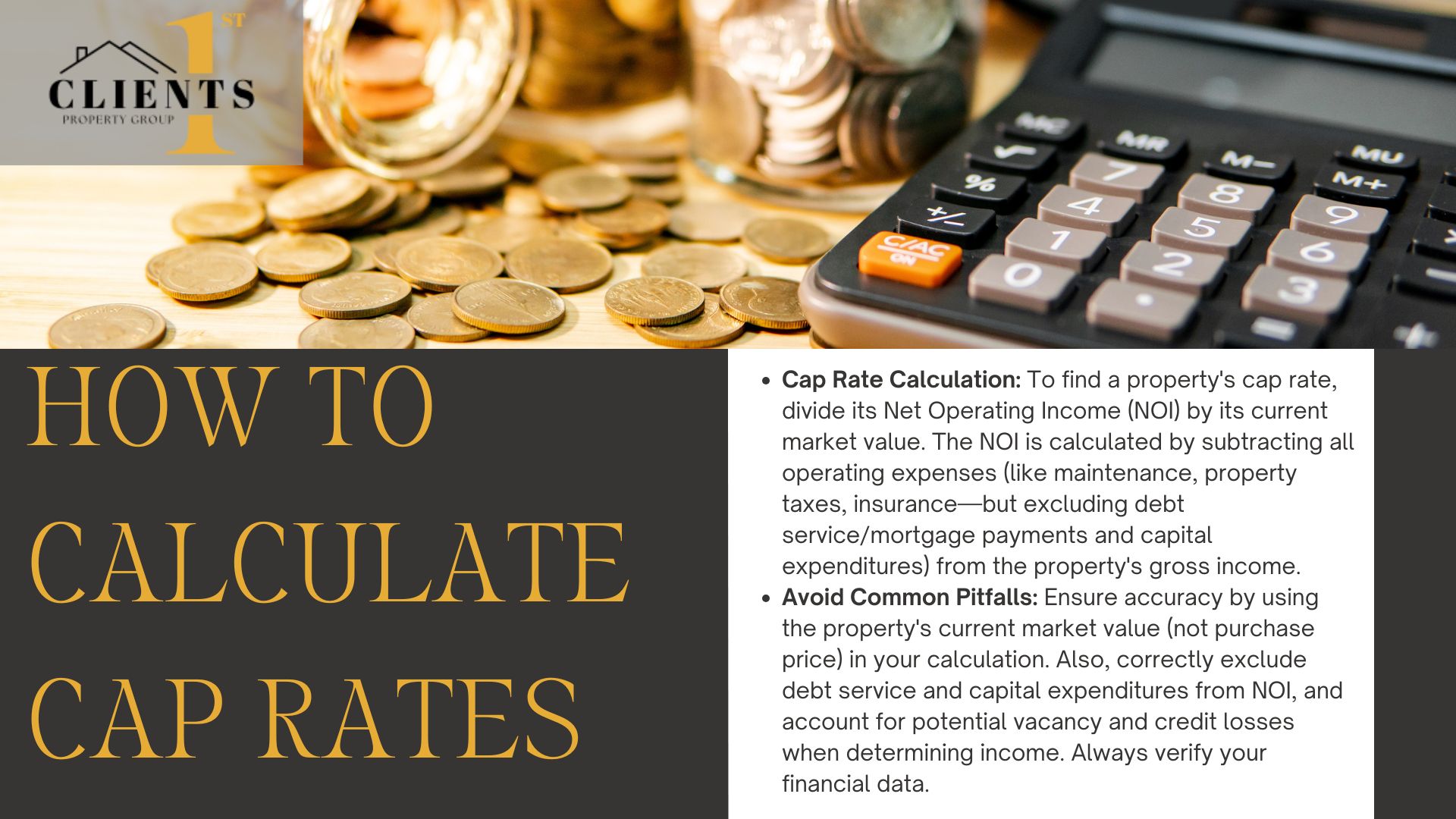
Understanding how to calculate cap rates is essential for making informed decisions in commercial real estate investing. The cap rate is a critical metric that helps investors evaluate the potential return on investment for a property.
Step-by-Step Calculation Process
To calculate the cap rate, investors need to follow a straightforward process. First, determine the property’s Net Operating Income (NOI) by subtracting operating expenses from gross income. Operating expenses include maintenance, property taxes, and insurance, but exclude debt service and capital expenditures.
| Gross Income | Operating Expenses | Net Operating Income (NOI) |
|---|---|---|
| $100,000 | $40,000 | $60,000 |
Next, divide the NOI by the property’s current market value to get the cap rate. For instance, if the NOI is $60,000 and the property value is $1,000,000, the cap rate would be 6%.
Common Calculation Mistakes to Avoid
Investors often make mistakes when calculating cap rates, which can lead to inaccurate assessments. Some common errors include using the property’s purchase price instead of its current market value, incorrectly including debt service in expense calculations, and failing to account for vacancy and credit losses.
- Using incorrect property valuation
- Including debt service in NOI calculations
- Ignoring vacancy and credit losses
- Misclassifying capital expenditures as operating expenses
To avoid these pitfalls, investors should maintain a consistent methodology, verify all financial information, and ensure they’re making appropriate adjustments for property-specific factors when calculating and comparing cap rates.
Interpreting Cap Rate Values
Interpreting cap rates correctly can significantly impact an investor’s ability to assess property value. Cap rates serve as a crucial metric in commercial real estate, helping investors understand the potential return on investment.
What Constitutes a “Good” Cap Rate
A “good” cap rate varies depending on the property type, location, and market conditions. Generally, a cap rate between 4% and 12% is considered reasonable, but the ideal rate depends on the specific investment goals and risk tolerance of the investor.
For instance, multifamily properties often have lower cap rates, typically ranging from 4% to 6%, due to their stable income streams and lower management intensity. In contrast, office properties may have higher cap rates, often between 6% and 9%, reflecting the higher risks associated with lease-ups and tenant improvements.
Cap Rates Across Different Property Types
Cap rates vary significantly across different commercial property types, reflecting their unique risk profiles and market dynamics. Recent data indicates that multifamily properties have a cap rate of around 6.10%, while industrial properties stand at 7.60%. Office properties have a cap rate of 8.90%, and retail properties are at 7.00%.
| Property Type | Cap Rate (%) |
|---|---|
| Multifamily | 6.10 |
| Industrial | 7.60 |
| Office | 8.90 |
| Retail | 7.00 |
Understanding these variations is crucial for investors to identify potential value opportunities when a property’s cap rate deviates from the norm for its category. As real estate markets continue to evolve, staying informed about cap rate trends across different property types will remain essential for making informed investment decisions.
The Relationship Between Cap Rates and Risk
Understanding the relationship between cap rates and risk is crucial for investors in commercial real estate. The surplus return available to property investors over Treasury bond investments can be attributed to the associated risks. These risks include factors such as property age, location, and status; property type; tenants’ solvency; lease terms; and overall market conditions.
Higher Cap Rates vs. Lower Cap Rates
Higher cap rates typically indicate higher risk associated with a property, reflecting factors like lower tenant creditworthiness or less favorable lease terms. Conversely, lower cap rates suggest lower risk, often seen in properties with high-quality tenants and stable cash flows. For instance, a property in a prime location with long-term leases to creditworthy tenants is likely to have a lower cap rate compared to a similar property in a less desirable location with shorter lease terms.
Risk Assessment Using Cap Rates
Cap rates serve as a fundamental risk assessment tool, providing investors with a standardized metric to evaluate and compare risk profiles. Sophisticated investors analyze cap rate spreads to determine if they’re being adequately compensated for the risks. The risk premium embedded in cap rates reflects numerous property-specific factors, including location quality and market liquidity.
As“The risk premium embedded in cap rates reflects numerous property-specific factors”, it’s clear that cap rates are not just simple metrics but complex indicators of a property’s risk profile. By analyzing historical cap rate trends, investors can identify potential market shifts and adjust their strategies accordingly. While cap rates provide a useful starting point for risk assessment, they should be supplemented with other metrics and qualitative factors to develop a comprehensive understanding of a property’s risk profile.
Factors That Influence Cap Rates
Understanding the factors that influence cap rates is crucial for making informed investment decisions in commercial real estate. Cap rates are not static; they are influenced by a variety of factors that can significantly impact the value and return on investment of a property.
Location and Market Conditions
Location and market conditions play a pivotal role in determining cap rates. Properties located in prime areas with high demand and limited supply tend to have lower cap rates due to their lower perceived risk and higher potential for long-term appreciation. Conversely, properties in less desirable locations may have higher cap rates to compensate for the increased risk.
Market conditions, including the overall state of the economy, interest rates, and the supply and demand for commercial real estate, also significantly impact cap rates. In a booming economy with low interest rates, cap rates may compress as investors are willing to accept lower returns due to the potential for long-term growth.
Property Type and Quality
The type and quality of a property are also critical factors that influence cap rates. High-quality properties with modern amenities, good condition, and strong tenant profiles tend to command lower cap rates. In contrast, properties that are outdated, require significant maintenance, or have a high risk of vacancy may have higher cap rates to reflect their higher risk profile.
Tenant Quality and Lease Terms
Tenant quality and lease terms are vital in determining cap rates. The creditworthiness of tenants, the length of leases, and the structure of lease agreements all impact the perceived risk and potential return of a property. For instance, properties leased to creditworthy tenants with long-term leases tend to have lower cap rates due to the stability and predictability of the income stream.
- Tenant creditworthiness significantly impacts cap rates, with investment-grade tenants commanding lower cap rates.
- Lease term length and structure, including provisions for rent escalations and renewal options, also influence cap rates.
- The type of lease, such as triple-net (NNN) or gross leases, affects cap rates, with NNN leases typically resulting in lower cap rates.
By understanding these factors, investors can better evaluate potential investments and make more informed decisions.
Cap Rates and Interest Rates
Cap rates and interest rates are interconnected factors that influence the attractiveness of commercial real estate investments. As interest rates fluctuate, they impact the overall cost of capital and, consequently, the cap rates that investors are willing to accept.
Impact of Interest Rate Changes on Cap Rates
Changes in interest rates have a direct effect on cap rates. When interest rates rise, the cost of borrowing increases, which can lead to higher cap rates as investors seek higher returns to compensate for the increased cost of capital. Conversely, when interest rates fall, cap rates may decrease as the cost of borrowing becomes cheaper, making investments more attractive at lower returns.
In 2024, cap rates increased nationally, but at a slower pace than in the previous year. According to CoStar data, multifamily, industrial, and office cap rates saw increases of 0.4% or more between Q2 2023 and Q3 2024. The anticipation of interest rate cuts in 2025 by the Fed could potentially lower borrowing costs and decrease cap rates, although the future remains uncertain.
Current Market Trends
Current market trends indicate that cap rates are increasing across most commercial property types, albeit at a slower pace than in previous years. This reflects a stabilizing interest rate environment.
- Multifamily cap rates have increased by approximately 0.4% between Q2 2023 and Q3 2024, impacted by higher financing costs and moderating rent growth.
- Industrial properties have seen cap rate expansion of about 0.6% over the same period as the post-pandemic e-commerce surge normalizes.
- Office properties face significant cap rate pressure, with increases of approximately 0.8% year-over-year, reflecting uncertainty about return-to-office trends.
| Property Type | Cap Rate Change (Q2 2023 – Q3 2024) |
|---|---|
| Multifamily | 0.4% |
| Industrial | 0.6% |
| Office | 0.8% |
| Retail | 0.1% |
Practical Examples of Cap Rate Analysis
To illustrate the practical application of cap rates in commercial real estate, let’s examine some real-world examples. Cap rate analysis is a critical tool for investors to evaluate the potential return on investment for various properties.
Office Building Investment
Consider an office building with a net operating income (NOI) of $50,000, expected to rise by 2% annually. If the investor’s expected rate of return is 10% per annum, the net cap rate would be 8% (10% – 2%). Using this cap rate, the asset valuation would be $625,000 ($50,000 / 8%). This example demonstrates how cap rates can be used to determine property value based on income and expected returns.
Multi-Family Property Evaluation
A 50-unit multi-family property in Charlotte is listed for $7.5 million, with units renting at slightly below market rates. The property generates $750,000 in annual rental income and an additional $50,000 from other sources, totaling $800,000. After accounting for a 5% vacancy and credit loss factor, and operating expenses of $310,000, the NOI is $450,000. The cap rate is 6% ($450,000 / $7.5 million), which is in line with similar properties in the area.
- The investor identifies value-add opportunities, such as upgrading unit interiors and improving common areas.
- Financial projections indicate that these improvements could increase the NOI to $525,000 within two years.
- This would improve the cap rate to 7% based on the original purchase price or support a higher property valuation of $8.75 million at the same 6% market cap rate.
This case study demonstrates how cap rate analysis can be used to evaluate a property’s current performance and quantify the potential impact of value-add strategies on future returns and property value.
Cap Rates vs. Other Investment Metrics
To get a complete picture of a commercial real estate investment’s performance, it’s essential to consider cap rates alongside other important metrics. While cap rates provide a snapshot of a property’s yield, other metrics offer additional insights into the investment’s overall viability.
Cap Rate vs. Return on Investment (ROI)
Return on Investment (ROI) is a broader metric that calculates the total return on an investment, including any appreciation in value, relative to its cost. Unlike cap rate, which focuses solely on the property’s income relative to its value, ROI considers the overall gain or loss, making it a more comprehensive measure of an investment’s performance. For instance, if a property appreciates significantly, its ROI will be higher than its cap rate, reflecting the total return on investment.
| Metric | Focus | Calculation Basis |
|---|---|---|
| Cap Rate | Property Income | Net Operating Income / Property Value |
| ROI | Total Return | (Gain from Investment – Cost of Investment) / Cost of Investment |
Cap Rate vs. Cash on Cash Return
Cash on Cash Return measures the annual cash flow relative to the actual cash invested, providing insight into the return generated by the cash component of the investment. This metric is particularly useful for investors using leverage, as it highlights the impact of financing on their returns. Unlike cap rate, which remains stable regardless of financing, Cash on Cash Return varies with debt terms, making it a dynamic metric that reflects the investor’s actual cash position.
Understanding the differences between cap rates, ROI, and Cash on Cash Return is crucial for investors to make informed decisions. Each metric provides a unique perspective on an investment’s performance, and together they offer a comprehensive view of its potential.
Conclusion: Making Informed Investment Decisions with Cap Rates
Investors must comprehend cap rates to assess the value and potential return of commercial properties effectively. By understanding cap rates, investors can compare different properties and make informed decisions in commercial real estate. Clients1st Property Group in Charlotte, North Carolina, offers expert guidance on cap rate analysis and interpretation. For personalized advice, contact them at (704)622-4865 to enhance your investment strategy and achieve your objectives.