

Navigating real estate terms can feel overwhelming, especially for first-time buyers. Clients 1st Property Group in Charlotte, NC, simplifies the process with clear, actionable insights. Let’s explore one of the most sought-after housing options: the standalone residential structure designed for one household.
Unlike multi-unit properties, these residences sit on their own land, offering dedicated outdoor space and private utilities. Ownership includes full control over the property, from landscaping to exterior modifications. Privacy and room to grow make this option popular among buyers prioritizing autonomy.
It’s worth noting that occupancy isn’t limited to traditional families. A single person, roommates, or unrelated individuals can legally reside in these homes. Clients 1st Property Group (704-622-4865) emphasizes understanding mortgage requirements and zoning laws early in the process to avoid surprises.
Key Takeaways
- Standalone structure on private land with no shared walls
- Full ownership of both building and property
- No occupancy restrictions based on family status
- Typically includes private utilities and outdoor space
- Mortgage terms differ from multi-family property loans
Introduction to Single-Family Homes and Their Importance

Your home’s structure influences daily life and long-term investment potential. In Charlotte’s competitive market, standalone properties remain a cornerstone of residential real estate. Clients 1st Property Group emphasizes how these dwellings offer unique advantages compared to multi-unit alternatives.
Defining Features in Housing Choices
Detached residences stand apart through exclusive land rights. Owners control their entire lot – from driveway designs to tree placement. This contrasts sharply with shared-space arrangements like condos, where exterior decisions often require group approval.
Financial and Lifestyle Impacts
Separate utility systems mean predictable monthly costs. “Charlotte buyers prioritize properties with individual meters,” notes a Clients 1st advisor. Proper classification affects loan approvals, as lenders assess detached homes differently than duplexes or townhouses.
Land ownership also impacts resale value. Standalone properties in Mecklenburg County appreciated 9% faster than attached homes last year. Buyers gain flexibility to expand living spaces or add amenities without neighbor negotiations.
Clients 1st Property Group (704-622-4865) helps navigate these nuances. Their team explains how zoning laws affect garage conversions or accessory dwelling units – critical considerations for growing families.
Understanding a Single-Family Home: Definition and Insights

Clarity in housing terminology empowers smarter decisions for buyers and investors alike. Legal definitions often determine financing options, zoning permissions, and long-term property value. Clients 1st Property Group emphasizes precise classification to align choices with buyer priorities.
Formal Definitions and Key Characteristics
Government agencies like the U.S. Census Bureau specify that these dwellings must be fully detached structures. No shared walls, roofing, or utility systems with adjacent properties. Ownership includes both the building and its land parcel, enabling full exterior control.
Contrary to common belief, occupancy isn’t limited to blood relatives. Unrelated individuals can legally reside together if the structure meets standalone criteria. This distinction affects everything from loan applications to renovation rights.
Distinguishing from Multi-Family Properties
Condominiums and duplexes operate under different frameworks. Shared walls in townhouses create collective maintenance responsibilities, while standalone residences place full accountability on the owner. Mortgage lenders often require higher down payments for multi-unit properties due to perceived risks.
Homeowners enjoy greater freedom to modify landscaping or add extensions without neighbor approvals. A Clients 1st advisor notes, “Loan officers assess detached properties differently—they’re seen as lower-risk investments.” This classification directly impacts insurance rates and resale strategies.
Understanding these distinctions saves time during property searches. Buyers can filter listings effectively and anticipate hidden costs associated with different housing types. Clients 1st’s team (704-622-4865) helps clients navigate these nuances, ensuring informed decisions align with lifestyle and financial goals.
Comparing Housing Options: Single-Family, Townhouse, and Condo
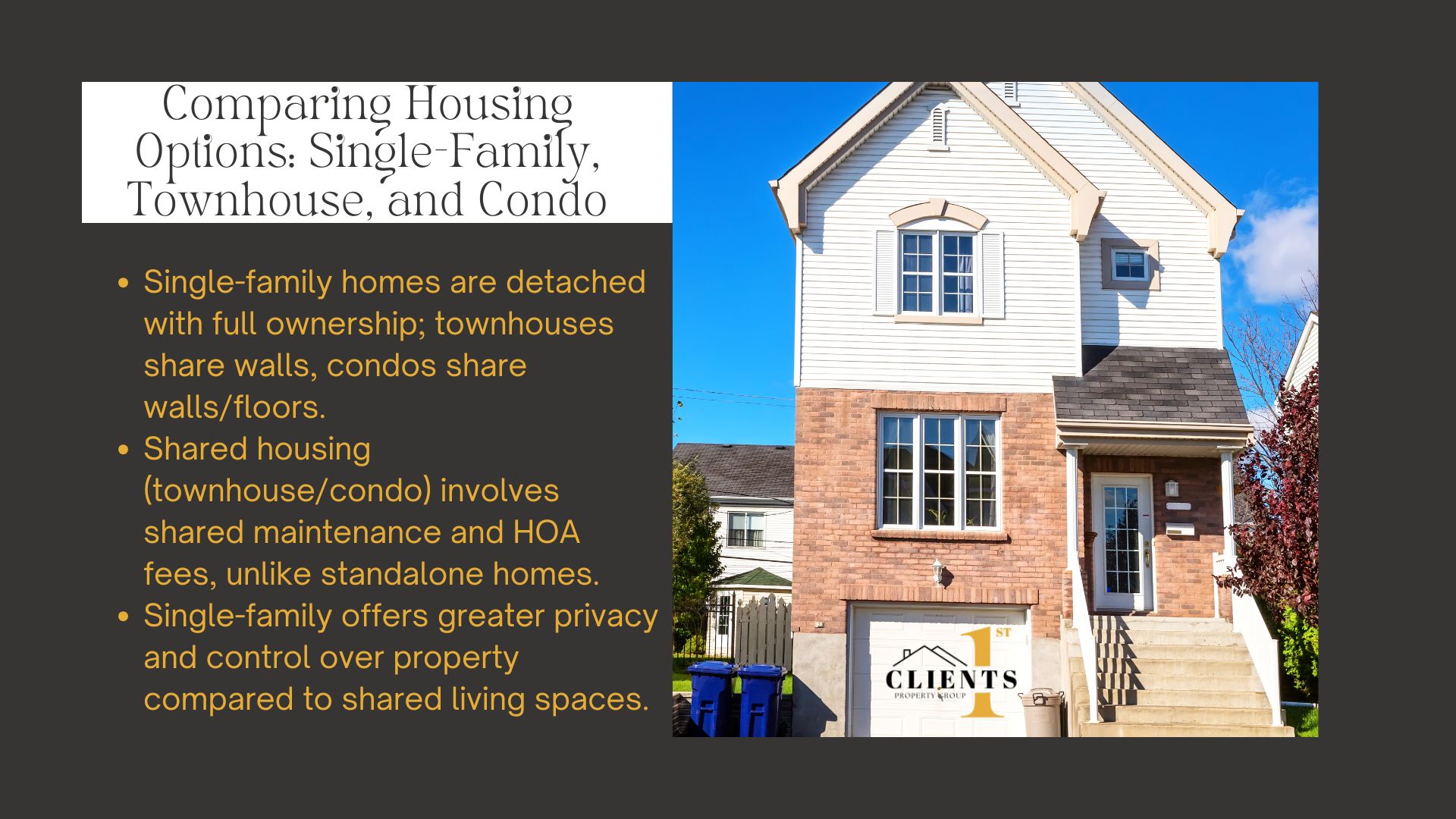
Choosing the right property type shapes your living experience and financial future. Standalone residences, townhomes, and condominiums each cater to distinct priorities – from privacy preferences to budget constraints. Let’s break down how structural designs and ownership models create unique advantages.
Differences in Structure and Ownership
Detached dwellings occupy their own land parcels with independent foundations. Townhouses often share side walls but maintain ground-to-roof separation – a key definition that sometimes qualifies them as standalone units. Condos typically stack vertically with shared ceilings and floors between units.
Ownership rights vary significantly. Condo buyers purchase airspace within a building, while townhome owners usually hold land rights beneath their unit. Standalone properties grant full control over both structure and yard – a major draw for those valuing customization.
Shared Walls, Utilities, and Community Aspects
Shared infrastructure impacts costs and responsibilities. Townhouse residents might split exterior maintenance fees, while condo associations often manage roofing and landscaping. Standalone homeowners bear all repair costs but avoid monthly community fees.
Consider these comparisons:
| Feature | Standalone | Townhouse | Condo |
|---|---|---|---|
| Wall Sharing | None | 1-2 sides | Multiple sides |
| Outdoor Space | Private yard | Small patio | Common areas |
| Fee Structure | None | Moderate HOA | High HOA |
Young professionals might prefer condos for low maintenance, while families often prioritize standalone units for backyard space. Clients 1st Property Group (704-622-4865) helps clients weigh these pros against personal needs and local market trends.
Financial Considerations and Mortgage Insights for Homeownership

Smart financial planning forms the backbone of successful property ownership. Charlotte residents face unique market dynamics where mortgage rates and land values influence long-term affordability. Clients 1st Property Group specializes in translating these factors into actionable strategies for buyers.
Monthly Mortgage Payments and Costs
Principal, interest, taxes, and insurance (PITI) create the foundation of housing expenses. Charlotte’s property tax rates average 0.85% – lower than national benchmarks but impactful over time. Consider this comparison:
| Expense Type | Standalone | Townhouse | Condo |
|---|---|---|---|
| Monthly PITI | $1,850 | $1,620 | $1,400 |
| Maintenance | $300 | $150 | $75 |
| HOA Fees | $0 | $120 | $280 |
A Clients 1st advisor notes, “Landscaping costs surprise many new owners – budget $100-$400 monthly depending on lot size.” These variables underscore why customized financial modeling proves essential.
Maintenance and Upkeep as a Financial Factor
Ongoing care of a standalone structure demands proactive budgeting. Roof replacements ($8,000-$15,000) and HVAC updates ($4,000-$12,000) occur every 10-20 years. Unlike condo dwellers, homeowners bear full responsibility for:
- Driveway repairs
- Fence maintenance
- Tree removal
Despite higher costs, 68% of Mecklenburg County residents report greater satisfaction managing their own properties. Clients 1st (704-622-4865) helps clients balance these realities with personalized cost projections and lender negotiations.
Benefits and Drawbacks: Pros and Cons of Single-Family Homes
Owning a standalone property brings distinct rewards and challenges that shape daily living and financial commitments. Clients 1st Property Group helps buyers evaluate these factors through Charlotte-specific market data and personalized consultations.
Privacy, Space, and Personalization Advantages
Detached residences eliminate shared walls, creating quiet environments ideal for families or remote workers. Owners control landscaping designs, exterior paint colors, and architectural updates without community approvals. Dedicated outdoor areas support gardens, play spaces, or future expansions.
Independent utility systems allow tailored energy solutions. Solar panel installations or tankless water heaters become feasible when not constrained by shared infrastructure. This autonomy often increases long-term property value in competitive housing markets.
Higher Costs and Management Responsibilities
Standalone structures require full oversight of repairs and maintenance. Roof replacements, lawn care, and HVAC servicing fall entirely on the homeowner. Compare annual costs:
| Expense | Standalone | Townhouse | Condo |
|---|---|---|---|
| Landscaping | $1,200 | $400 | $0 |
| Exterior Repairs | $3,500 | $1,800 | $500 |
| Utility Systems | Full cost | Partial sharing | Shared |
Clients 1st advisors note, “Savvy buyers offset these costs through energy-efficient upgrades negotiated during purchase.” While townhouses offer lower maintenance, they limit customization options critical for growing households.
Balancing freedom with responsibility requires strategic planning. Partnering with local experts helps homeowners anticipate hidden expenses while maximizing their property’s potential.
Legal, Zoning, and Ownership Aspects in Single-Family Homes
Property classifications carry legal weight that impacts everything from renovations to resale potential. Agencies like the U.S. Census Bureau set strict criteria for detached residences, requiring complete utility separation and independent lot access. Clients 1st Property Group helps buyers verify these standards during due diligence.
Understanding Legal Definitions and Utility Separations
Zoning laws demand standalone structures to have private utility connections. Shared water lines or electrical systems could reclassify a property as multi-unit. Local governments also enforce minimum lot sizes – typically 6,000 sq. ft. in Charlotte suburbs – to maintain neighborhood character.
Legal classifications differ from casual descriptions. A house with an accessory dwelling unit (ADU) might still qualify if both units share one owner. However, renting the ADU could trigger zoning violations without proper permits. “Zoning exceptions exist but require thorough documentation,” advises a Clients 1st specialist.
| Requirement | Single-Family | Multifamily |
|---|---|---|
| Utility Independence | Mandatory | Optional |
| Minimum Lot Size | Varies by zone | Smaller allowances |
| Occupancy Rules | No restrictions | Per-unit limits |
Ownership rights face challenges when properties straddle zoning boundaries. Detached homes near commercial areas might face usage restrictions affecting market value. Clients 1st (704-622-4865) reviews title documents and municipal codes to prevent costly oversights.
Prospective buyers should prioritize properties with clear utility demarcation. Separate meters for water and electricity simplify maintenance disputes. While standalone structures offer autonomy, their legal protections depend on precise adherence to zoning ordinances.
Real Estate Investment Insights: Single-Family Homes as an Asset
Investors seeking stable returns increasingly focus on residential properties with standalone structures. Charlotte’s market shows these dwellings generate 23% higher annual returns than multi-unit buildings. Clients 1st Property Group highlights three key factors driving this trend: tenant demand, tax advantages, and flexible financing.
Long-Term Lease Periods and ROI Benefits
Families often rent standalone properties for 2-3 years, minimizing turnover costs. Steady cash flow pairs with lower property taxes – Mecklenburg County rates average 0.85% versus 1.1% for modular homes. Conventional loans for these structures often require 15-20% down, compared to 25-30% for multi-family units.
| Investment Type | Avg. Lease Term | Maintenance Cost | HOA Fees |
|---|---|---|---|
| Standalone | 24 months | $2,100/yr | $0 |
| Modular Home | 18 months | $1,800/yr | $75/mo |
| Condo | 12 months | $900/yr | $280/mo |
Potential Vacancies and HOA Considerations
While vacancies average 8% lower than apartments, marketing periods can stretch during economic downturns. Properties with shared walls in townhome communities often face stricter rental rules. One Clients 1st advisor notes, “Investors avoid 37% of HOA disputes by choosing standalone lots.”
Buyers should compare loan terms carefully. FHA loans for modular homes sometimes carry higher interest rates. Strategic investors balance lower upfront costs against long-term appreciation potential. Clients 1st (704-622-4865) tailors financial models to individual risk profiles, ensuring optimal asset allocation.
Expert Tips for Prospective Buyers and Homeowners in Charlotte, NC
Charlotte’s dynamic real estate market demands strategic planning for both newcomers and seasoned investors. Current trends show median prices stabilizing near $385,000, with Steele Creek and NoDa emerging as high-demand neighborhoods. Remote work flexibility continues driving interest in properties offering home office spaces and upgraded connectivity.
Local Market Insights and Property Trends
Recent data reveals 22% of buyers prioritize energy-efficient features to offset rising utility costs. Compare popular housing types:
| Type | Median Price | Days Listed |
|---|---|---|
| Detached | $395,000 | 28 |
| Townhome | $315,000 | 19 |
| Condo | $275,000 | 14 |
First-time buyers should explore FHA loans requiring 3.5% down payments. Investors note rental yields averaging 6.8% in university-adjacent areas.
How Clients 1st Property Group Can Assist You
“We decode complex processes,” says a Clients 1st advisor. Their team provides:
- Customized cost breakdowns for maintenance and renovations
- Neighborhood-specific zoning law explanations
- Mortgage rate negotiation strategies
Understanding ownership responsibilities early prevents budget surprises. For personalized guidance on Charlotte’s competitive market, contact Clients 1st Property Group at (704) 622-4865.
Conclusion
Making informed property decisions requires balancing priorities like privacy, space, and financial flexibility. Standalone residences offer dedicated outdoor areas and full ownership control – advantages condos and townhouses can’t match. However, maintenance responsibilities demand careful budgeting for repairs and upgrades.
Legal distinctions matter. Proper zoning classification protects renovation rights and resale value. While initial costs appear higher than multi-unit options, long-term appreciation often justifies the investment. Renters and buyers alike value the privacy these properties provide, free from shared walls or community rules.
Consider your lifestyle needs against financial realities. Families prioritizing personalization find value in standalone structures, while investors appreciate stable returns. For money-wise strategies tailored to Charlotte’s market, consult Clients 1st Property Group.
Ready to explore your options? Call (704) 622-4865 for expert guidance that turns complex decisions into confident choices. Your ideal property – and future – await.