


Savvy investors know property values don’t just rise passively. Strategic upgrades and operational adjustments can accelerate growth far beyond typical market trends. This hands-on approach, often called forced appreciation, allows owners to directly influence their asset’s worth by boosting net operating income (NOI).
Unlike natural appreciation—which depends on external factors like neighborhood demand—this method focuses on controllable improvements. Renovating units, optimizing rent structures, or reducing vacancies all contribute to higher NOI. A stronger NOI translates to increased property valuation, creating opportunities for refinancing or profitable sales.
Both commercial and residential holdings benefit from these tactics. For example, upgrading a multifamily building’s amenities can justify higher rents, while energy-efficient systems in single-family homes reduce long-term costs. Clients1st Property Group specializes in identifying and executing these value-boosting strategies across Charlotte, North Carolina, and beyond.
This guide explores actionable steps to maximize returns through forced appreciation. You’ll learn how cap rates connect to NOI, discover renovation best practices, and review case studies demonstrating measurable results. Ready to take control of your investment’s potential? Reach Clients1st at (704) 622-4865 for tailored guidance.
Key Takeaways
- Active strategies outperform passive market reliance for growing property value.
- Net operating income (NOI) directly impacts valuation through cap rate calculations.
- Operational efficiency upgrades often deliver faster returns than cosmetic changes.
- Commercial and residential assets both benefit from forced appreciation methods.
- Local expertise, like Clients1st’s team, ensures context-specific improvements.
Introduction to Forced Appreciation
Property owners have two paths to growing equity: waiting or acting. While natural appreciation relies on external factors like neighborhood development, strategic enhancements let investors directly impact their asset’s worth. This proactive approach transforms underperaning buildings into high-value holdings through measurable improvements.
Defining Forced vs. Natural Appreciation
Market-driven growth occurs slowly as demand increases over years. Forced appreciation accelerates this timeline through upgrades that boost net operating income (NOI). Renovating kitchens, automating maintenance, or adjusting lease terms all contribute to higher cash flow—directly influencing valuation through cap rate calculations.
Consider a rental home with outdated fixtures. Installing energy-efficient appliances reduces utility costs while justifying higher rents. Both actions lift NOI, creating immediate value growth instead of waiting for area prices to rise.
Why Active Strategies Matter Now
Today’s competitive markets reward hands-on management. With housing inventory fluctuating, investors who optimize operations achieve faster returns. Reducing vacancies through targeted marketing or renegotiating service contracts can increase profitability within months.
Clients1st Property Group helps owners implement these tactics effectively. Their Charlotte-based team analyzes each asset’s potential, balancing renovation costs with projected rent increases. This tailored approach ensures upgrades deliver maximum returns while maintaining tenant satisfaction.
Exploring What is Forced Appreciation in Real Estate
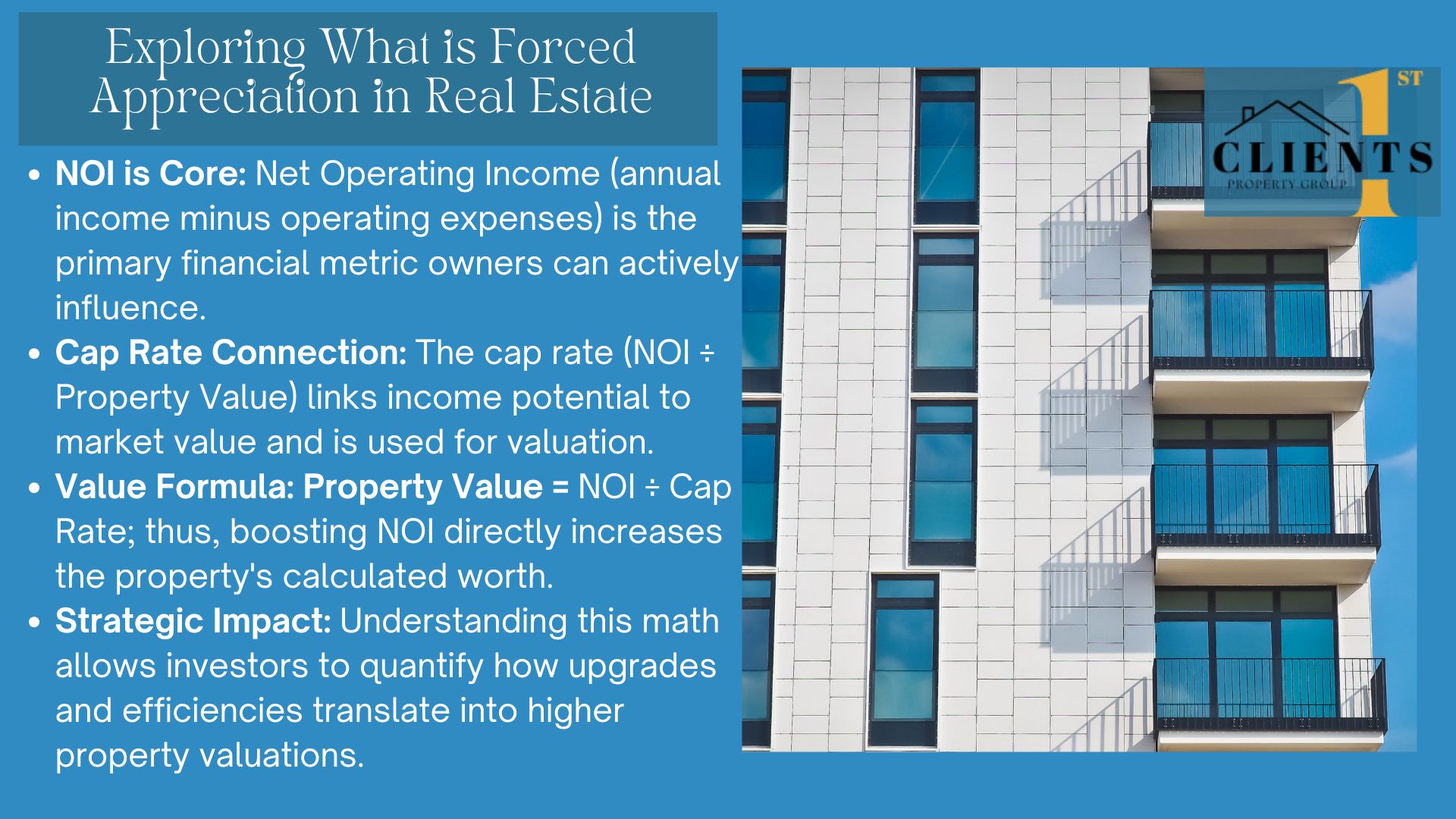
Key financial concepts drive value creation in property investments. To unlock growth, owners must master three interconnected metrics: net operating income (NOI), cap rates, and valuation formulas. These tools transform abstract market trends into actionable strategies.
Key Concepts and Terminology
Net Operating Income (NOI): Total annual income minus operating expenses. This excludes mortgage payments or taxes. For example, a 10-unit rental generating $120,000 yearly with $40,000 in costs has an NOI of $80,000.
“Increasing NOI by just 10% can boost a property’s value by six figures in competitive markets.”
Cap Rate: A percentage reflecting a property’s return potential. Calculated as NOI ÷ Property Value. Lower rates often signal higher-demand areas. A $1M asset with $80,000 NOI has an 8% cap rate.
| Term | Role in Valuation | Actionable Levers |
|---|---|---|
| NOI | Directly multiplies value | Rent increases, expense cuts |
| Cap Rate | Market-driven multiplier | Location selection, asset class |
| Occupancy | Impacts gross income | Tenant retention, marketing |
The formula Value = NOI ÷ Cap Rate shows how improvements compound. Raising NOI by $12,000 in an 8% cap rate market adds $150,000 to valuation. This math underpins strategic upgrades like modernizing units or renegotiating vendor contracts.
Understanding these terms helps investors quantify risks and forecast returns. Later sections will explore specific tactics to optimize NOI through operational tweaks and renovations.
Strategies to Boost Net Operating Income and Property Value
Strategic upgrades transform underperforming assets into profit engines. By focusing on two levers—operational tweaks and physical enhancements—investors create immediate value growth. Clients1st’s Charlotte team regularly implements these methods, achieving 12-18% NOI increases for local owners.
Operational Efficiencies and Cost Reductions
Streamlining operations often delivers faster returns than major renovations. Consider these actionable steps:
- Conduct energy audits to reduce utility costs by 15-25%
- Renegotiate vendor contracts for landscaping or maintenance
- Implement digital rent collection to minimize vacancies
“Every dollar saved through efficiency measures directly boosts your property’s worth,” notes Clients1st’s operations lead.
| Strategy | NOI Impact | Timeframe |
|---|---|---|
| Energy upgrades | $200/unit yearly | 3-6 months |
| Lease automation | 2% vacancy reduction | Immediate |
| Bulk purchasing | 8% cost savings | 30-60 days |
Property Improvements and Renovations
Targeted upgrades justify rent increases while enhancing market appeal. A $10,000 kitchen remodel in a Charlotte duplex allowed $150/month rent hikes—boosting annual NOI by $3,600. At a 7% cap rate, this added $51,428 to the property’s value.
Effective improvements include:
- Installing smart home technology
- Upgrading to energy-efficient windows
- Adding community amenities like laundry facilities
These strategies work across asset types. A local investor increased commercial property value by 22% through HVAC upgrades and tenant retention programs. Clients1st’s specialists help calculate exact ROI using cap rate formulas, ensuring upgrades align with market demands.
Hands-On Approaches for Commercial and Residential Investors
Proactive asset management transforms underperforming holdings into revenue powerhouses. These real-world examples demonstrate how strategic upgrades create measurable results across property types.
Case Studies from Multifamily and Commercial Assets
A Charlotte-based 20-unit apartment complex increased monthly rents by 12% after kitchen remodels and landscaping upgrades. Annual NOI rose $28,800, boosting its value by $411,428 at a 7% cap rate. Operational changes like automated rent collection further reduced vacancies by 18%.
In commercial real estate, Clients1st helped reposition a dated office building. Renegotiating leases with shared utility costs and adding coworking spaces lifted occupancy from 65% to 92%. The $56,000 NOI increase translated to $933,333 in added value using the area’s 6% average cap rate.
“These projects prove targeted improvements outperform market averages. Investors can replicate these models by focusing on tenant needs and local demand drivers.”
| Asset Type | Strategy | Value Gain |
|---|---|---|
| Multifamily | Unit upgrades + tech integration | $411k |
| Commercial | Space reconfiguration + lease terms | $933k |
Key takeaways: Analyze tenant demographics before renovations, prioritize expense reduction alongside rent increases, and monitor cap rate trends when planning exits. Clients1st’s team provides customized feasibility assessments to maximize these strategies.
Expert Insights from Clients1st Property Group
Charlotte’s dynamic real estate landscape demands more than generic strategies. Success hinges on understanding neighborhood-specific demand drivers and zoning nuances. Clients1st Property Group combines granular market data with hands-on asset management to maximize returns for investors.
Local Market Expertise in Charlotte, North Carolina
South End’s tech boom and NoDa’s arts district require distinct approaches. The team analyzes micro-markets to identify upgrades that align with tenant demographics. Recent projects include:
- Converting outdated office spaces into hybrid work-ready units near uptown
- Implementing solar panels in SouthPark luxury rentals to attract eco-conscious tenants
- Negotiating bulk service contracts for multifamily complexes in University City
“Charlotte’s 7.3% annual rent growth outpaces national averages. Strategic improvements here yield 20-30% higher NOI lifts compared to passive holdings.”
Three factors make local knowledge critical:
| Factor | Charlotte Impact | Client1st Solution |
|---|---|---|
| Job Growth | Financial sector expansion | Targeted commercial upgrades |
| Transit Development | Silver Line light rail | Value-add near stations |
| Tax Incentives | Energy efficiency rebates | ROI-focused renovations |
Owners who partnered with Clients1st achieved 14% average annual returns through these localized tactics. For personalized guidance on cap rate optimization or lease restructuring, contact their specialists at (704) 622-4865. Their team provides free consultations to align your assets with Charlotte’s evolving opportunities.
Forced Appreciation Strategies to Boost NOI and Property Value
Owners who actively enhance their assets often outpace market trends. By focusing on controllable factors like operational efficiency and strategic upgrades, investors directly shape their property’s financial performance. Case studies show how targeted improvements—from energy audits to amenity additions—boost net operating income and valuation.
Understanding metrics like cap rates helps quantify these efforts. While market conditions influence long-term growth, deliberate enhancements create immediate value lifts. Combining natural market movements with hands-on strategies maximizes returns over time.
Ready to transform your holdings? Clients1st Property Group tailors solutions to Charlotte’s unique opportunities. Their team identifies cost-saving upgrades and rent optimization tactics that align with local demand. Call (704) 622-4865 today for actionable insights—turn your property into a high-performing asset through calculated, expert-guided improvements.