

More than 22% of eviction cases in Mecklenburg County come from not knowing North Carolina’s laws. At Clients 1st Property Group, we’ve guided many landlords through summary ejectment. This is the state’s way of removing tenants while keeping things fair and protecting property.
In North Carolina, following the law is key when dealing with lease issues or unpaid rent. Our team knows Charlotte’s housing market well. We use our knowledge and talk to tenants early to avoid problems.
Key Takeaways
- Summary ejectment is North Carolina’s legal framework for property repossessions
- Nonpayment and lease breaches account for 89% of local eviction cases
- Proper notice periods and court filings determine case outcomes
- Local expertise matters in Charlotte’s fast-moving rental market
- Early intervention often resolves issues before legal action becomes necessary
We focus on stopping problems before they start with good tenant screening and lease education. But if issues do come up, our Charlotte team makes sure everything is done right. Knowing the law helps landlords avoid big mistakes and respect tenant rights.
Understanding the Eviction Process in Charlotte

Landlords in Charlotte must follow strict state and local rules to remove tenants. North Carolina’s eviction laws, found in N.C. Gen. Stat. § 42-3, require careful notice and documentation. Mecklenburg County courts make sure these rules are followed.
North Carolina Eviction Laws Overview
State law has three main rules for evictions in Charlotte:
- Written notices must clearly state the lease violations
- Landlords cannot legally change locks or shut off utilities
- Proof of proper notice delivery is needed for court filings
Mobile home parks have their own rules. Landlords must give 10-day notices for rent defaults before going to court.
Grounds for Eviction in Charlotte
There are valid reasons for eviction:
Nonpayment of Rent
Tenants get a 10-day notice to pay or leave after missed payments. Partial payments won’t stop an eviction unless the landlord agrees to accept them as full payment.
Lease Violations
We handle cases of unauthorized guests, banned pets, or criminal activity. For drug offenses or property damage, landlords can file for eviction right away.
Holdover Tenancy
Tenants who stay after their lease ends get a 7-day notice to leave for month-to-month agreements. For fixed-term leases, no renewal notice is needed unless the contract says so.
Step-by-Step Eviction Process in Mecklenburg County

Knowing the eviction steps in Mecklenburg County can save landlords from delays. The county follows strict North Carolina laws. These laws cover lease violations and unpaid rent.
Serving Proper Notice
Every eviction starts with a legal notice. Without the right documents, courts throw out cases right away.
Notice to Quit Requirements
North Carolina has three types of notices:
- 10-Day Notice for unpaid rent
- 7-Day Notice for lease violations
- Immediate Notice for criminal activity
Acceptable Service Methods
Mecklenburg County accepts three ways to deliver notices:
- Hand delivery by sheriff’s deputy
- Certified mail with return receipt
- Posting on tenant’s door if other methods fail
Filing with Mecklenburg County Court
After notice, landlords file through the NC eCourts portal. This system makes things easier but needs exact documents.
Required Documentation
Get these ready for filing:
- Completed AOC-CVM-201 complaint form
- Copy of lease agreement
- Proof of notice delivery
- Payment records showing arrears
Filing Fees and Procedures
The filing fee is $96 for summary ejectment cases. You can pay online or in-person. Cases usually show up on the magistrate’s docket in 3 business days.
Court Hearings and Judgments
Mecklenburg County courts quickly handle eviction cases. But, the outcome depends on how the tenant responds.
Tenant Response Options
Renters have three options after getting a summons:
- Pay owed rent to stop eviction
- File written answer contesting claims
- Appear in court for defense
Contested vs Uncontested Cases
Uncontested cases often lead to immediate eviction. Contested cases need a full hearing. Tenants have 10 days to appeal if they lose.
Legal Requirements for Charlotte Landlords
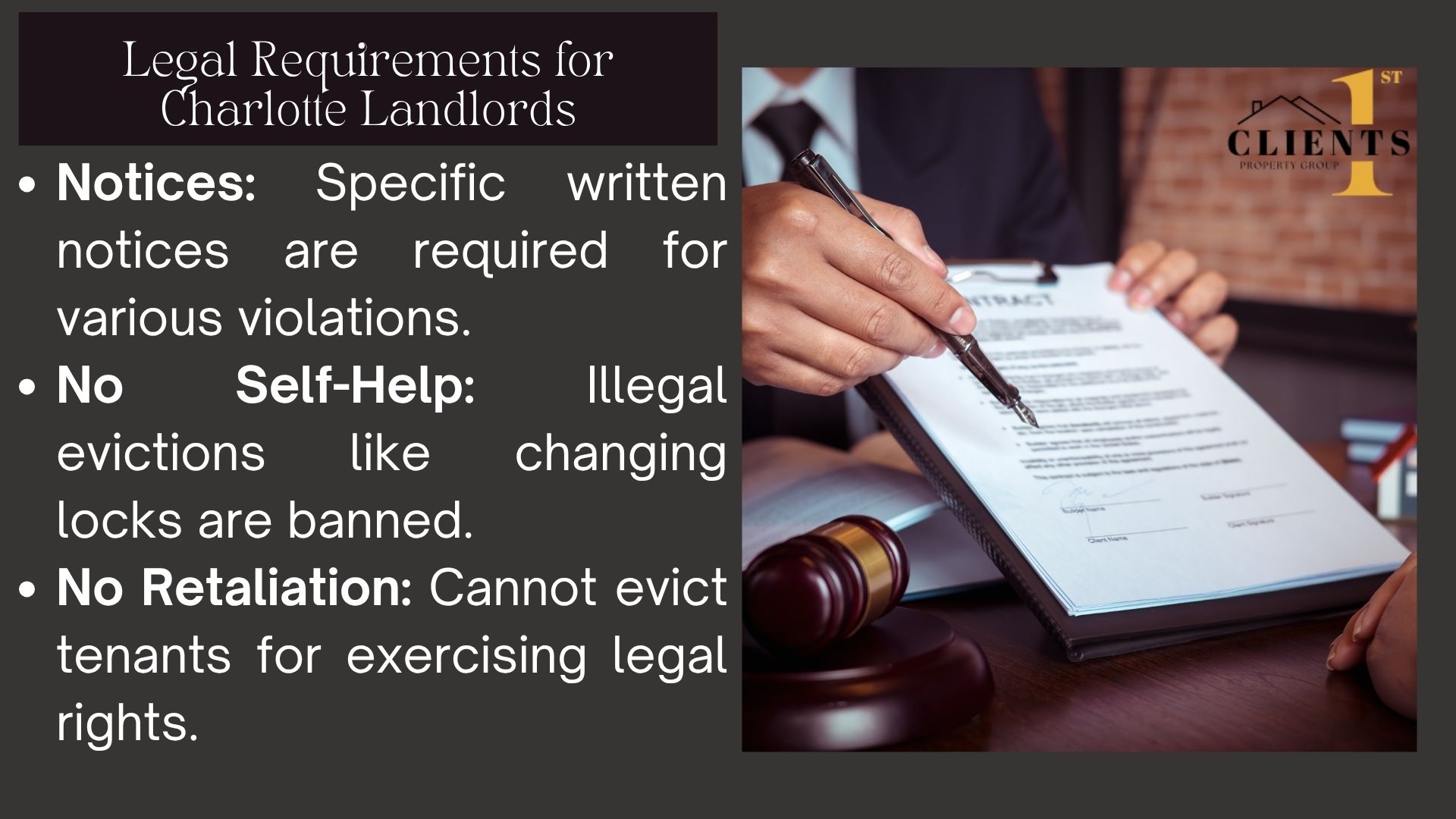
Following North Carolina eviction laws is key for both landlords and tenants. We help landlords understand their legal duties to avoid costly mistakes when removing tenants.
Mandatory Notice Periods
Charlotte’s housing rules demand specific notice times before starting eviction actions. These times change based on the type of lease violation:
10-Day Notice for Nonpayment
Landlords must give tenants 10 days to pay overdue rent. The notice should include:
- Exact rent amount owed
- Payment deadline date
- Accepted payment methods
Immediate Notice for Violations
Some lease breaches allow for quicker action under the eviction laws:
- Illegal drug activity
- Property damage over $1,500
- Immediate safety threats
Prohibited Eviction Practices
North Carolina bans these common landlord mistakes:
Self-Help Eviction Restrictions
Actions like changing locks or cutting off utilities are illegal “self-help” evictions. Courts can order:
- Triple monthly rent compensation
- Immediate property re-entry
- Legal fee reimbursement
Retaliatory Action Protections
N.C. Gen. Stat. § 42-37.1 protects tenants who use their legal rights, such as:
- Reporting housing code violations
- Requesting essential repairs
- Joining tenant organizations
We assist landlords in understanding these rules to safeguard their rental business.
Typical Eviction Timeline in North Carolina
Knowing the eviction process timeline is key for landlords and tenants. North Carolina law sets clear deadlines for each step. We’ll outline these stages based on Mecklenburg County’s rules and state laws.
From Notice to Court Filing
Every eviction starts with a written notice. The notice type decides how fast the case moves forward.
Minimum Waiting Periods
For not paying rent, tenants get a 10-day notice to pay or leave. Lease violations get a “cure or quit” notice, also for 10 days. But, criminal activity or property damage can lead to immediate eviction.
Tenant Cure Rights
Tenants can stop evictions by fixing issues before deadlines. This includes paying rent or removing banned items. Landlords must accept valid fixes and keep records of all talks.
Court Process Duration
If tenants don’t comply, landlords file a “summary ejectment” lawsuit. Courts in Mecklenburg County usually hold hearings 7–30 days after filing.
Summary Ejectment Procedures
- Day 1: File complaint at courthouse
- Day 3–7: Tenant receives summons
- Day 10–30: Hearing held
Appeal Considerations
Tenants have 10 days to appeal a bad judgment. They must pay rent into court escrow during appeals. Missing payments means they can’t stay.
Post-Judgment Enforcement
Winning a judgment doesn’t mean immediate possession. Final steps need law enforcement’s help.
Writ of Possession Timeline
Landlords ask for this court order 5 days after judgment. Sheriffs serve it in 48 hours, then schedule evictions 7–10 days later.
Sheriff Involvement Process
Officers give 24-hour notice before arriving. Tenants must leave by the deadline. If not, deputies will remove their belongings. North Carolina lets tenants keep items valued under $500 for 7 days.
How We Help Navigate Charlotte Evictions
Facing tenant evictions in Charlotte needs precision and local knowledge. Our proven process helps. We make every step smooth while protecting your rights as a property owner.
Our Eviction Process Management
We take care of the hard parts so you don’t make costly mistakes:
Notice Preparation and Service
Our team creates legally correct notices using North Carolina’s templates. We make sure they are delivered right and keep records for court.
Court Documentation Assistance
We handle everything from filing summonses to organizing evidence for Mecklenburg County courts. Our system keeps track of deadlines so you never miss a key date.
Legal Compliance Assurance
We make sure your actions follow state laws:
NC Landlord-Tenant Law Expertise
Our experts check every decision against Legal Aid of NC and local court rules. We avoid self-help evictions and other banned practices.
Lease Agreement Review
We check your rental contracts to make your eviction case stronger. Our reviews find missing clauses or terms that can slow down the process.
Contact Clients 1st Property Group
Our local knowledge is key to success in Charlotte eviction cases.
Local Expertise You Can Trust
We’ve been handling Mecklenburg County cases for 14 years. We know how local magistrates interpret laws. Our office at 4421 Stuart Andrew Blvd helps landlords all over the metro area.
Schedule Consultation Today
Begin with a free 15-minute strategy session. Call (704) 622-4865 or visit our South End office to talk about your case. We offer same-day appointments for urgent cases.
Ensuring Smooth, Legal Evictions in Charlotte, NC
Understanding Charlotte’s eviction process is key. It’s about following the law and finding solutions. At Clients 1st Property Group, we focus on clear talks and sticking to North Carolina’s tenant laws.
We help landlords meet Mecklenburg County’s rules. At the same time, we protect tenant rights as the state requires.
Knowing the eviction process can save time and money. Landlords must give the right notices and not use self-help evictions. If tenants need help, Legal Aid of North Carolina or Charlotte Center for Legal Advocacy can assist.
We make eviction processes faster but always ethically. Our steps include serving notices and enforcing judgments. Talking things out often solves problems before court.
Good property management means knowing local laws well. We handle cases like nonpayment and lease issues with North Carolina’s laws in mind. For smooth evictions in Charlotte, work with experts who value both law and people.