

Office buildings represent a significant portion of the commercial real estate landscape in the United States, accounting for 20% of all commercial properties. Despite their volatility, they offer lucrative investment opportunities for both novice and experienced investors. The value of these properties is determined by their income potential, which can be enhanced through strategic tenant selection, lease management, and expense reduction.
Clients1st Property Group, based in Charlotte, North Carolina, provides expert guidance on navigating the complexities of office building investments. With their extensive knowledge, investors can make informed decisions and capitalize on the potential of commercial real estate. For personalized advice, you can reach out to them at (704)622-4865.
Key Takeaways
- Understand the fundamentals of office building investments and their differences from residential real estate.
- Learn strategies for enhancing the income potential of office buildings.
- Discover the importance of market analysis and property selection in commercial real estate.
- Gain insights into effective tenant management and risk mitigation techniques.
- Explore expert advice from industry professionals at Clients1st Property Group.
The Fundamentals of Office Building Investments
As the commercial real estate landscape evolves, understanding the basics of office building investments is crucial for investors. The future of office spaces is being shaped by factors such as hybrid work models, vacancies in older buildings, and the increasing influence of environmental, social, and governance (ESG) factors on demand.
Current Market Trends in Commercial Real Estate
The current market trends in commercial real estate are characterized by a divergence in the performance of Class A properties versus their Class B and C counterparts. According to Moody’s Analytics, Class A office vacancies were at 18% in Q1, while Class B and C offices saw a vacancy rate of 20.2%. This disparity highlights the importance of property quality in investment decisions.
The Role of Office Buildings in Investment Portfolios
Office buildings play a significant role in investment portfolios, offering a tangible asset class that can provide stable income through leases. Investors should consider the strategic location of office buildings, as well as their potential for long-term appreciation in value.
Expert Insights from Clients1st Property Group in Charlotte
Clients1st Property Group in Charlotte emphasizes the importance of focusing on properties with strong fundamentals rather than speculative opportunities. Their experts stress that understanding local market dynamics, including employment growth and infrastructure development, is key to successful office building investments. For personalized advice, investors can contact Clients1st Property Group at (704) 622-4865.
- Successful office investors prioritize properties with strong fundamentals.
- Understanding local market dynamics is crucial for navigating Charlotte’s commercial real estate sector.
- Clients1st Property Group offers tailored guidance for investors, providing insights into neighborhood-specific opportunities and challenges.
4 Compelling Reasons to Invest in Office Buildings
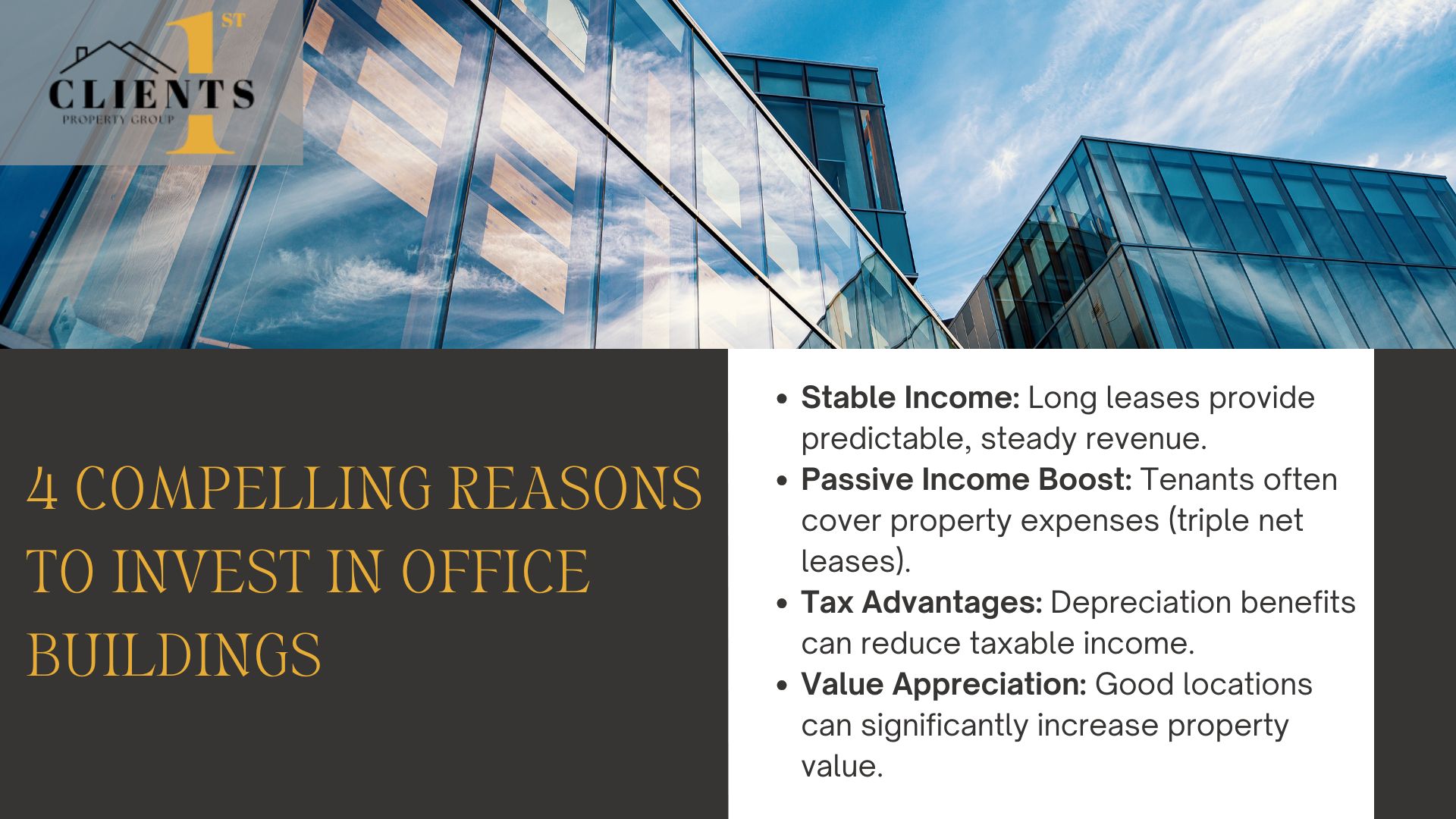
For investors seeking stable returns, office buildings are an attractive option due to their potential for long-term income. Investing in office buildings can provide a steady stream of revenue through rental income, making them a valuable addition to any investment portfolio.
Long-Term Income Through Extended Leases
Office buildings often feature extended leases, providing investors with a predictable income stream. This stability is particularly appealing in volatile market conditions.
Triple Net Leases and Passive Income Potential
Many office building leases are structured as triple net leases, where tenants cover property expenses, enhancing the passive income potential for investors. This arrangement can significantly reduce the financial burden on investors.
Depreciation Tax Benefits for Investors
Investing in office buildings also offers depreciation tax benefits. Investors can claim depreciation on the property’s value, reducing taxable income and increasing overall returns.
Strategic Location Advantages in Growing Markets
Office buildings located in strategic areas, such as growing business districts or near transportation hubs, can appreciate significantly in value over time. Identifying the right area to invest in office space is crucial for maximizing returns.
As noted by industry experts, “strategic location selection is crucial when you invest in office buildings, as properties in emerging or revitalizing business districts can experience substantial appreciation as the area develops.” This insight underscores the importance of careful location analysis when considering an investment in office buildings.
Office Buildings vs. Residential Real Estate: Key Differences
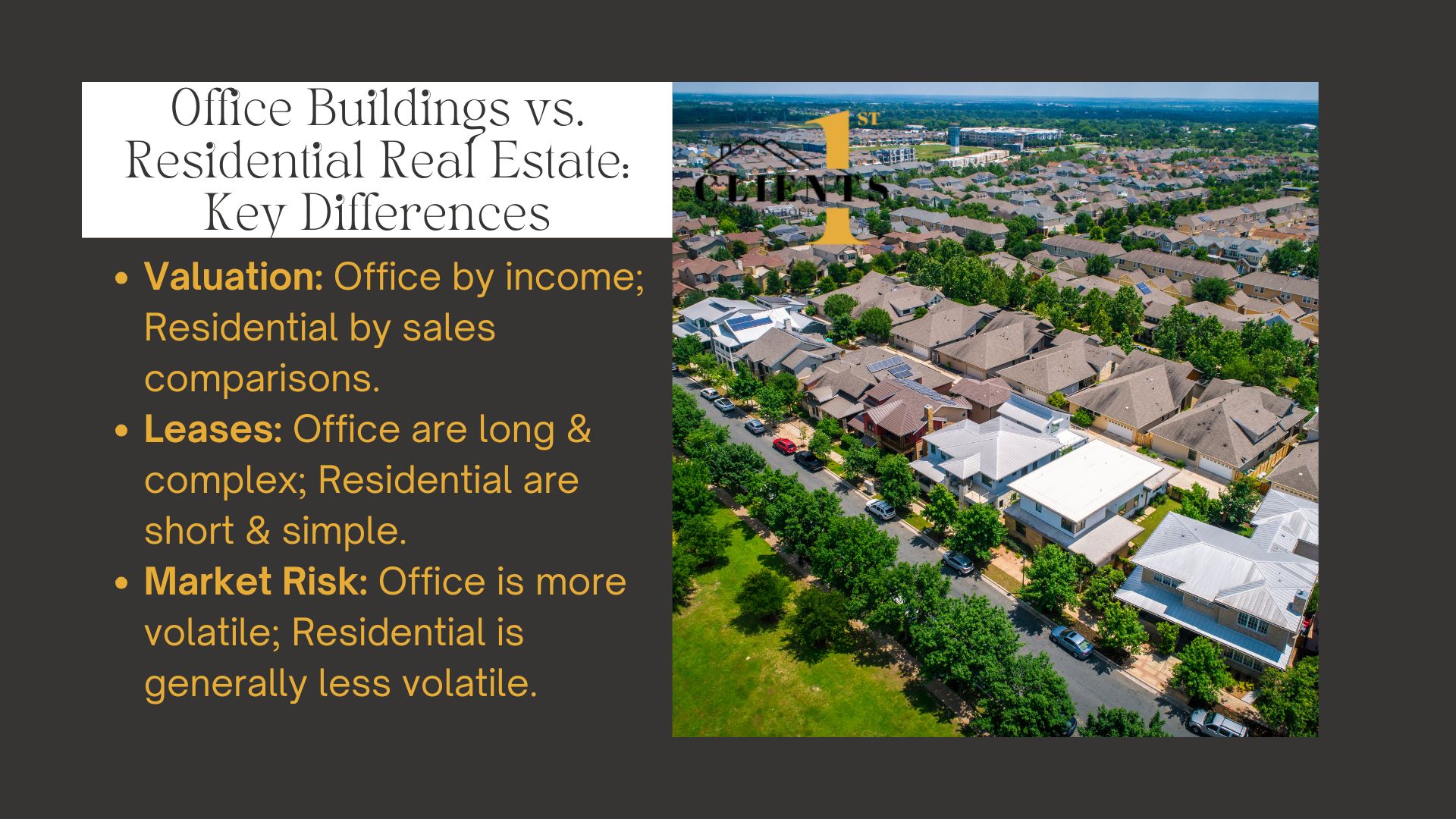
Office buildings and residential properties exhibit different characteristics that can significantly impact investment returns and risk exposure. Understanding these differences is crucial for making informed investment decisions in the commercial real estate market.
Income-Based Valuation vs. Comparable Sales
Office buildings are typically valued based on their income-generating potential, whereas residential properties are often valued using comparable sales data. This fundamental difference in valuation methodology can lead to distinct investment strategies.
Lease Terms and Tenant Relationships
Commercial leases for office buildings tend to be longer and more complex than residential leases, resulting in more stable cash flows but also higher stakes for tenant relationships. As a noted expert once said, “The key to successful commercial real estate investing lies in understanding the nuances of lease agreements and fostering strong tenant relationships.”
Market Volatility Considerations
The market for office buildings is closely tied to economic cycles, experiencing greater volatility than residential properties. During economic downturns, office buildings may face higher vacancy risks, making it essential for investors to time their acquisitions and dispositions carefully within the commercial real estate cycle.
By recognizing these key differences, investors can better navigate the complexities of investing in office buildings versus residential real estate, ultimately making more informed decisions in the real estate market.
How to Invest in Office Buildings: A Step-by-Step Approach
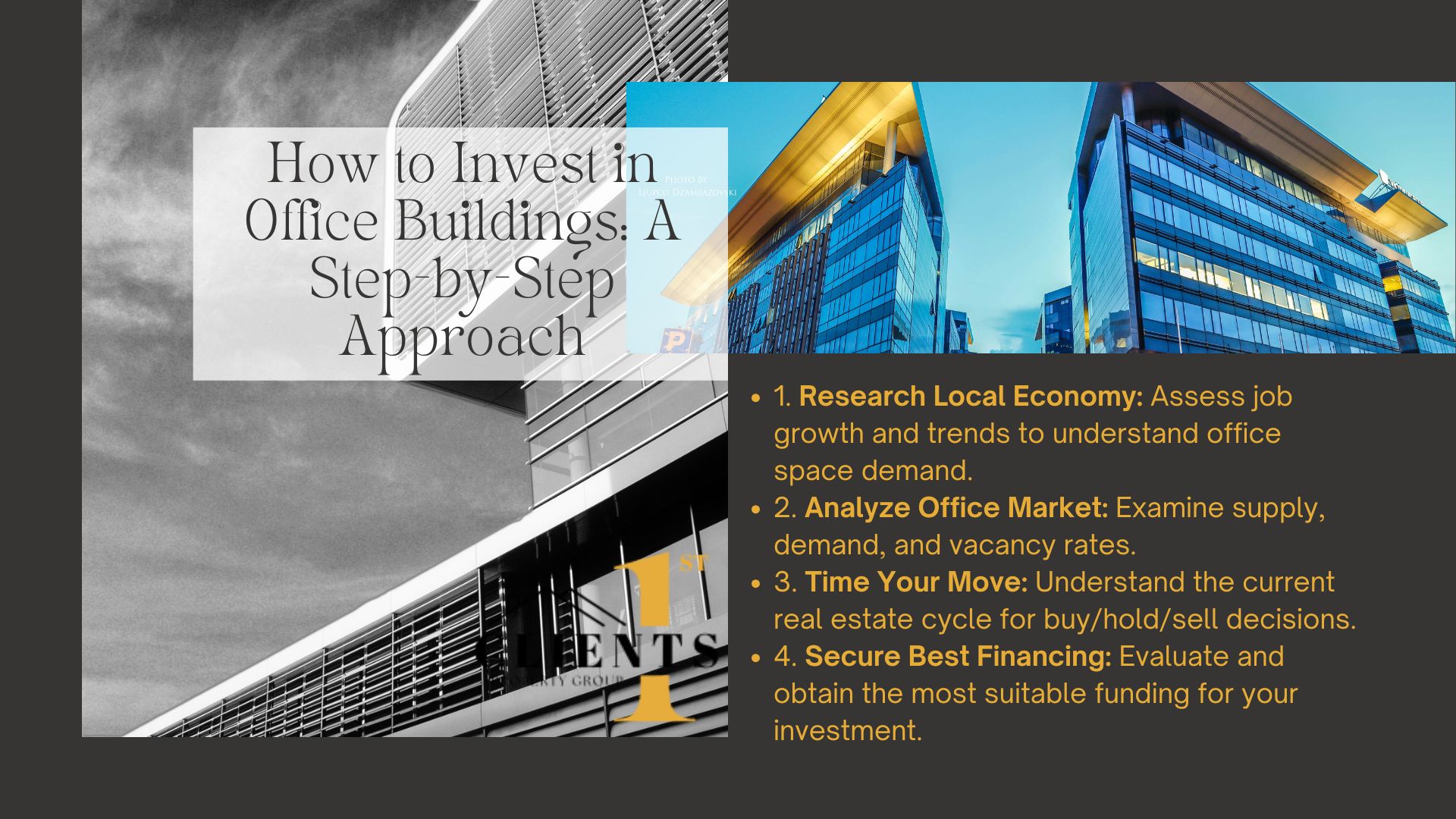
The process of investing in office buildings involves several key steps that help mitigate risks and maximize returns. As an investor, understanding these steps is crucial for making informed decisions in the commercial real estate market.
Step 1: Research Economic Fundamentals and Job Growth
Begin by researching the local economy, focusing on job growth, industry diversification, and population trends. A strong economy with growing employment opportunities is more likely to have a high demand for office space, making it an attractive investment.
Step 2: Analyze Supply, Demand, and Vacancy Rates
Analyze the supply and demand for office space in the target market, including vacancy rates and the types of properties available. Understanding these dynamics helps investors identify opportunities and potential challenges.
Step 3: Understand the Real Estate Cycle Timing
Timing is crucial in real estate investing. Understanding where the market is in the real estate cycle can help investors make more informed decisions about when to buy, hold, or sell their office building investments.
Step 4: Secure Appropriate Financing Options
With nearly $1.5 trillion of commercial real estate debt due for repayment before the end of 2025, securing the right financing is critical. Evaluate various financing options, including traditional commercial mortgages, SBA loans, and private equity partnerships, to find the best fit for your investment.
Types of Office Buildings and Which to Choose
Office buildings come in various forms, each with its unique characteristics and investment potential. Understanding these differences is key to making informed investment decisions.
Building Classifications: Class A, B, and C Properties
Office buildings are typically classified into three categories: Class A, B, and C. Class A properties are modern, high-quality buildings in prime locations, commanding top rents. Class B buildings are well-maintained but may not be as modern or prestigious as Class A. Class C properties are older and may require significant renovation. The classification of a building significantly impacts its attractiveness to tenants and its potential for long-term income.
Building Heights: High-Rise, Mid-Rise, and Low-Rise Options
The height of an office building is another critical factor. High-rise buildings offer prestige and visibility, often in central business districts. Mid-rise buildings balance cost and prestige, while low-rise buildings are typically found in suburban areas, offering more parking and lower costs. The choice between these options depends on the target tenants and the local market.
Specialty Office Properties: Medical, Government, and R&D
Specialty office properties cater to specific industries, such as medical offices, government buildings, and research and development facilities. These properties often have unique requirements but can offer stable income due to their specialized nature. For instance, medical office buildings benefit from stable, credit-worthy tenants and recession-resistant demand, making them an attractive option for investors looking for secure space.
10 Essential Office Building Investment Terms to Know
To navigate the complex world of office building investments, it’s essential to familiarize yourself with critical terminology. Understanding these key terms will empower you to make informed decisions and avoid potential pitfalls.
Space Measurements: Gross Area vs. Rentable Area
In office building investments, understanding the difference between gross area and rentable area is crucial. Gross area refers to the total floor area, while rentable area is the portion that generates rental income. This distinction affects how you calculate rental income and expenses.
Lease and Rent Terminology
Lease terms can significantly impact your investment’s cash flow. Familiarize yourself with terms like “lease term,” “rent escalation,” and “concessions.” These elements can influence your property’s income and overall value.
Common Area Maintenance and Tenant Improvements
Common area maintenance (CAM) charges cover the upkeep of shared spaces. Tenant improvements (TIs) are renovations made for tenants. Understanding who bears these costs—landlord or tenant—is vital for predicting expenses and maintaining profitability.
Operating Expenses and Capitalization Rate
Operating expenses encompass costs like property taxes, insurance, and maintenance, typically ranging from $8-15 per square foot annually. The capitalization rate (cap rate) is a critical metric that represents the ratio of net operating income to the purchase price, helping investors evaluate potential returns.
By grasping these essential terms, you’ll be better equipped to navigate the world of office building investments and make decisions that align with your financial goals.
The ABCs of Office Building Leases
Office building leases form the backbone of commercial real estate investments, dictating cash flow and profitability. Understanding the different types of leases and their implications is crucial for investors to make informed decisions.
Gross Leases: Tenant Benefits and Landlord Responsibilities
Gross leases simplify expenses for tenants by bundling operating costs into a single rent payment. Landlords are responsible for managing and paying property expenses, which can be beneficial in maintaining tenant relationships. However, this structure may lead to higher base rents to account for potential expenses.
Triple Net Leases: Maximizing Passive Income
Triple Net (NNN) leases offer landlords a way to maximize passive income by passing property expenses directly to tenants. Tenants pay their proportionate share of real estate taxes, insurance, and maintenance costs in addition to base rent. This structure is popular in commercial real estate for its clarity in expense allocation.
Modified Gross Leases and Negotiation Strategies
Modified gross leases represent a middle ground between gross and NNN leases, offering flexibility. Landlords and tenants can negotiate expense allocations based on their needs. Key negotiation strategies include establishing clear expense stops and defining base-year expenses to ensure a mutually beneficial agreement.
When negotiating any office building lease, it’s essential to remember that every term is potentially negotiable. Engaging experienced professionals can help secure favorable terms and avoid costly oversights.
- Modified gross leases offer a compromise between gross and triple net structures.
- Successful negotiation involves establishing clear expense stops and defining base-year expenses.
- Everything in a lease is negotiable, from rental rates to renewal options.
Tenant Selection and Risk Management
Tenant selection and risk management play a vital role in ensuring the profitability of office building investments. As an investor, it’s crucial to adopt a strategic approach to selecting tenants and managing associated risks.
Credit Worthiness: The Most Important Factor
When evaluating potential tenants, credit worthiness is the most critical factor. Investors should assess the financial stability of companies looking to lease office space. This involves reviewing their credit history, financial statements, and business reputation. A thorough credit assessment helps mitigate the risk of default and ensures a stable cash flow.
Diversifying Tenant Mix and Lease Expirations
Diversification is key to managing risk in office building investments. By having a diverse mix of tenants across various industries, investors can reduce their exposure to market fluctuations. Additionally, staggering lease expirations can prevent a situation where multiple leases expire simultaneously, thereby maintaining a consistent income stream.
Creating Contingency Plans for Vacancies
To protect yourself from potential vacancies, it’s essential to establish a reserve fund. This fund should cover 3-6 months of operating expenses and debt service for each major tenant space. According to Clients1st Property Group in Charlotte, proactive strategies include developing relationships with commercial real estate brokers and creating a flexible tenant improvement budget. For instance, one effective strategy is to consider temporary or alternative uses for vacant spaces, such as short-term executive suites or co-working arrangements.
| Risk Management Strategy | Description | Benefits |
|---|---|---|
| Establishing a Cash Reserve | Setting aside funds to cover potential vacancies | Ensures financial stability during vacancy periods |
| Diversifying Tenant Mix | Having tenants from various industries | Reduces exposure to market fluctuations |
| Proactive Tenant Retention | Initiating retention strategies 12-18 months before lease expiration | Increases the likelihood of lease renewals, reducing vacancy risks |
By implementing these strategies, investors can effectively manage risks associated with tenant selection and vacancies, ensuring a more stable return on their office building investments. For more information on navigating office building investments, you can contact Clients1st Property Group at (704) 622-4865.
Maximize Office Building Returns with Clients1st Property Group
Successful office building investments hinge on informed decision-making and local market expertise. Clients1st Property Group in Charlotte, North Carolina, offers comprehensive support for investors in the commercial real estate market. Their expertise includes market analysis, acquisition guidance, and ongoing management tailored to your investment goals. By partnering with experienced professionals, you can navigate the evolving landscape of office building investments. For personalized guidance, contact Clients1st Property Group at (704)622-4865 to discuss your real estate investment strategy and objectives.