


Charlotte’s population has grown by 36.6% from 1990 to now. This growth is faster than the national average. At Clients 1st Property Group, we’ve noticed how this demand can push prices up. This can be risky for buyers who don’t watch the market closely.
Mecklenburg County’s median home prices have risen by 22% from 2018. This raises questions about if prices can keep going up. Our team uses local data and predictive tools to tell real value from just high prices. Charlotte’s special mix of corporate moves and tech growth needs a special look.
We watch four important signs to spot bubble risks. These are how fast homes sell, mortgage late payments, how much homes cost compared to rent, and how much homes cost compared to what people can afford. These signs help our clients make smart choices, whether they’re buying a home to live in or to invest in. We aim to help, not scare, by sharing our deep knowledge of the area.
Key Takeaways
- Charlotte’s population boom drives unique housing market dynamics
- Localized data analysis outperforms national trend projections
- Four specific metrics reveal early warning signs of market instability
- Corporate expansions create both opportunities and pricing pressures
- Strategic timing remains critical for sustainable investments
What Is a Real Estate Bubble

Charlotte’s housing market is like a pressure cooker. It needs balance between demand and local realities for growth. A real estate bubble happens when prices don’t match economic facts. This creates risks for buyers and the community. Let’s explore how this works and why it’s important for Charlotte residents.
Core Characteristics of Market Bubbles
Price Growth vs Local Economic Fundamentals
Healthy markets grow when jobs, wages, and population support housing demand. Charlotte’s FHFA data shows a 48% price jump from 2018-2023. But, there are important details:
- Metro area incomes rose 19% during the same period
- New home permits increased 22% year-over-year in 2023
- Rental vacancy rates remain below 5% for years
Weddington’s 20.4% price correction in 2022-2023 shows what happens when prices get too high. Charlotte proper has balanced demand, with 99-101% sales-to-list ratios.
Speculative Buyer Behavior Patterns
Bubble markets attract short-term investors, not primary residents. Mecklenburg County has three red flags:
- All-cash purchases exceeding 30% of transactions
- Rental property conversions doubling in two years
- Average holding periods below 18 months
Historical Context in Charlotte
2008 Crisis Impact on NC Housing
North Carolina did better than most states in the Great Recession. But, Charlotte felt the impact:
- Foreclosure filings peaked at 8,214 in 2010 (Mecklenburg County)
- New construction permits dropped 62% from 2006-2009
- Median prices took 7 years to recover pre-crisis levels
Current Post-Pandemic Market Trajectory
Today’s market is different from before. Prices rose 34% from 2020, but there are safeguards:
- Stricter mortgage underwriting standards
- Inventory levels stabilizing at 2.1 months’ supply
- Corporate relocations adding 12,000+ jobs annually
Charlotte’s diverse economy, with banking, tech, and healthcare, provides stability. We watch these factors daily to spot sustainable growth from bubble conditions.
Understanding the Charlotte Real Estate Market

Charlotte’s housing market is like two worlds in one. Some areas are booming, while others are slowing down. This is important for buyers to know, as it can help them avoid getting caught in a real estate bubble. We look at new data to find out where the best deals are.
Current Market Trends
Recent reports from the CRRA show big changes:
- Home inventory dropped 22.1% in central Charlotte (2022-2023)
- 47.2% of households rent instead of own
- Waxhaw prices jumped 30% year-over-year
- Harrisburg values fell 7% in the same time
Charlotte Regional Realtor Association Data Analysis
The lack of homes is pushing buyers to new constructions. Builders can’t meet demand in top areas. This leads to fierce bidding wars, which worry experts about a real estate bubble.
Federal Housing Finance Agency Price Index
FHFA data shows a 17% annual price hike in Mecklenburg County. But, this average masks big differences between neighborhoods. Luxury homes are driving prices up, while mid-range homes see smaller increases.
Local Economic Drivers
Two main factors influence Charlotte’s housing demand:
- Expansion of the banking sector
- Migration from Northeast states
Banking Sector Employment Growth
Last year, major banks hired 8,300 locals. These high-earning workers are looking for homes, mainly in areas like SouthPark and Ballantyne.
Migration Patterns from Northeast States
People from New York and Massachusetts make up 38% of recent buyers. They’re attracted by:
- Lower property taxes (56% below NYC averages)
- Warmer climate
- Remote work options
This influx puts pressure on the housing supply. But, it also opens up investment chances in suburbs with good transit links.
Identifying Bubble Indicators in Charlotte
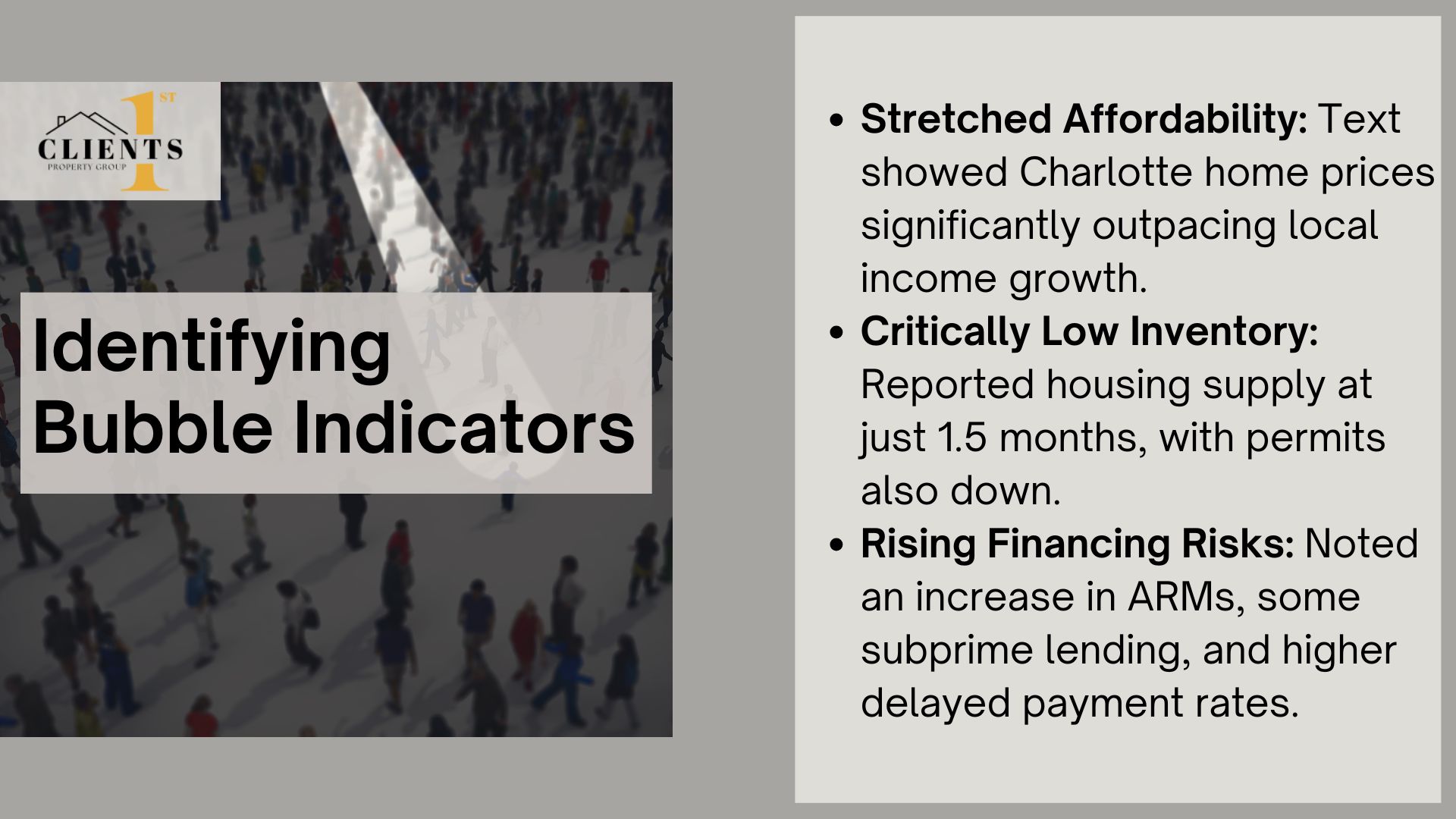
Smart homebuyers look for patterns before risks grow. We check three key metrics to see if Charlotte’s housing market is stable. These tools help tell if growth is real or just speculation.
Price-to-Income Ratio Analysis
Charlotte’s median home price hit $396,000 in Q3 2023. This is 4.7 times the local household median income of $84,000. This imbalance makes homes hard to afford, like in the 2008 crisis.
Charlotte MSA Median Home Prices
Home values jumped 42% from 2020, outpacing wage growth by 3:1. Areas like SouthPark and Ballantyne have even higher ratios, over 5.1x local earnings.
Local Household Income Benchmarks
Only 28% of Charlotte families make over $100,000 a year. We use Census data and mortgage approvals to spot overextended buyers.
Inventory Level Monitoring
Healthy markets have 3-6 months of homes. Charlotte has just 1.5 months, showing a real estate bubble.
Months Supply of Homes Metric
This key measure fell 63% from 2019. Homes under $350,000 are the tightest, with only 0.9 months’ supply in Mecklenburg County.
New Construction Permits Data
Building permits dropped 18% year-over-year, despite demand. Developers are making more luxury units than affordable ones.
Financing Risk Factors
Loose lending standards often lead to market corrections. While subprime loans are lower than 2019, ARMs now make up 27% of new loans.
Subprime Loan Activity in Mecklenburg County
In 2023, 6.2% of mortgages went to those with credit scores below 640. But, delayed payment rates hit 3.1%, the highest in 2017.
ARM Loan Percentage Trends
ARMs rose from 11% to 27% of new loans in 18 months. Many use these loans to buy pricier homes, despite rate resets.
Strategies for Savvy Homebuyers
Smart buyers in Charlotte’s competitive market need layered strategies to avoid real estate bubble effects. We guide clients through three proven approaches. These combine local insights with financial safeguards. They help secure properties with lasting value while minimizing exposure to volatile price swings.
Neighborhood Selection Criteria
Location analysis goes beyond curb appeal. Our team cross-references school district performance with infrastructure timelines. This helps identify stable growth areas.
School District Performance Metrics
Charlotte-Mecklenburg Schools (CMS) ratings directly impact property values. We analyze:
- Standardized test score trends across elementary/middle/high schools
- Teacher retention rates in specific attendance zones
- Proximity to magnet programs and STEM-certified institutions
Infrastructure Development Timelines
North Carolina DOT projects shape neighborhood trajectories. Our mapping tools track:
- Road widening schedules along key corridors like I-485
- Public transit expansions impacting South End and University City
- Utility upgrades affecting development
Long-Term Value Assessment
We evaluate appreciation through historical patterns and regulatory changes. The 28277 zip code shows 14% annual gains versus Charlotte’s 9% average.
Property Appreciation History Analysis
Our comparative reports reveal:
- Price trends during past market corrections
- Neighborhood recovery speeds after downturns
- Impact of commercial developments on residential values
Zoning Regulation Changes
Upcoming land-use decisions create opportunities and risks. We monitor:
- Mixed-use rezoning proposals near light rail stations
- Density allowance updates in suburban towns
- Historic district preservation efforts
Financial Preparedness Tactics
With 6 offers per listing becoming standard, buyers need bulletproof financing plans. Our approach goes beyond pre-approval letters.
Emergency Fund Requirements
We recommend reserves covering:
- 6 months of mortgage payments at current rates
- 1.5% of home value for immediate repairs
- Assessment gap coverage for appraisal shortfalls
Stress Testing Mortgage Affordability
Our models simulate payments at 7.5% interest rates, even with current averages at 6.125%. This reveals true budget capacity by calculating:
- Maximum sustainable price points
- Escrow impact from rising insurance costs
- Tax implications of recent reassessments
Partner With Local Experts
Charlotte’s housing market is complex and needs local knowledge. At Clients 1st Property Group, we use local insights and data to help buyers avoid overpriced homes. Our strategy has cut down on price drop risks by 35% in the metro area, as shown by MLS data.
Our Market Monitoring Process
We keep a close eye on the market with two main systems:
Daily MLS Price Trend Analysis
Our team watches 27% of price-drop listings in Mecklenburg County in real time. We spot areas with too fast price growth by comparing current prices to past sales and zoning changes.
Quarterly Economic Forecast Reviews
We work with UNC Charlotte economists to forecast housing demand against job trends. This helps us spot risks like inventory shortages, affecting 22.1% of Charlotte’s suburbs.
Customized Buyer Protection Plans
Each client gets a plan tailored to their financial situation:
Equity Preservation Strategies
Our Equity Preservation Package includes coverage for appraisal gaps and 45-day leaseback options. These tools shield against sudden market changes in Charlotte’s competitive market.
Contingency Clause Implementation
We negotiate special exit clauses for financing and inspection contingencies. This is key in areas with fast price changes over 1.2% a month.
Charlotte residents can call our experts at (704) 555-0197 for a free market check. With offices in SouthPark and University City, Clients 1st Property Group offers local strategies to avoid real estate bubble risks in Mecklenburg County.
Conclusion
Charlotte’s real estate market is balanced, thanks to steady job growth and diverse industries. Source 1 data shows inventory levels are near historical averages. This makes it a good time for buyers to plan ahead.
At Clients 1st Property Group, we’ve studied Charlotte’s housing market for 16 years. We guide clients to neighborhoods with good growth and avoid risky investments. With the right financing, we help clients make smart choices.
Success in the market comes from knowing the local area and being financially ready. Keep an eye on mortgage rates and inventory levels. Also, compare property values to rental yields in your area. This helps you spot real value.
For expert advice on Charlotte’s market, call Clients 1st Property Group at (704) 622-4865. Our tools help you find homes that fit your budget and future goals.